
Loans for apprentices in the UK: costs and repayment terms
An apprenticeship doesn’t automatically give you access to student finance. Apprentices aren’t eligible for student loans because an apprenticeship is treated as a job. So, loans for apprentices in the UK usually means considering personal borrowing for a specific cost.
If you’re considering a loan, it’s sensible to understand the figures before applying. The amount you may be offered and the repayments depend on the loan terms and your circumstances. Lenders assess details such as your income, payment history and credit record.
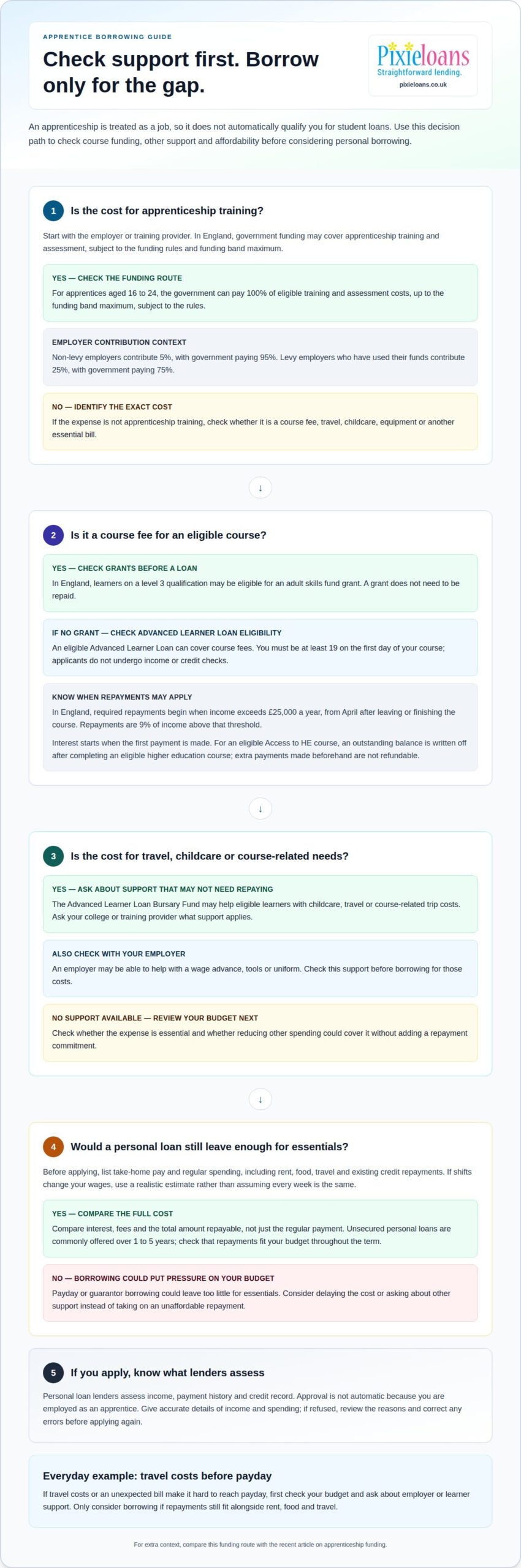
This guide explains when borrowing may help, how to compare costs and repayment terms, and what to expect from an application and credit check. For example, if travel costs or an unexpected bill make it hard to reach payday, start by checking your budget and whether you can manage repayments alongside rent, food and travel. You’ll also learn how an Advanced Learner Loan differs from a personal loan, so you can focus on the option that fits the cost you need to cover. For context, compare this with a recent article on apprenticeship funding.
Key Takeaways
- Check whether course or apprenticeship funding could cover the cost before considering borrowing.
- Compare how repayments work and what they could mean for your take-home pay.
- Understand how income, payment history and credit history can affect a personal loan application.
- Work out what you can comfortably repay after essentials such as rent, food and travel.
Use of loans where apprenticeship or grant funding is unavailable
In England, levy status shapes training funding; loans may help if grants fall short.
Funding when apprenticeship support is unavailable
Average apprentice pay is £20,124. According to Department for Business and Trade, minimum pay is £8 per hour in year one or under 19. Non-levy employers contribute 5%, with government paying 95%; levy employers who have used their funds contribute 25%, with government paying 75%.
Help with apprenticeship-related costs
An eligible Advanced Learner Loan can cover course fees. Bursaries may help with travel or childcare; ask your employer about wage advances, tools or uniform support. Budget repayments before considering a short-term loan for another essential cost.
Comparing loan costs and repayment terms
When comparing personal loans, check the total repayable, interest and any fees, not just the regular payment. Payday or guarantor borrowing could put pressure on a tight budget if repayments leave too little for essentials.
For an Advanced Learner Loan, repayments begin when income exceeds £25,000 a year, from April after leaving or finishing the course. Student Finance England says repayments are 9% of income above the threshold. Interest starts when the first payment is made, so compare the balance and repayment terms before making voluntary extra payments.
Before applying, check your budget and use the loan application form if you decide to proceed.
Repayment length is another part of the comparison: a regular payment may look manageable while the full repayment period still affects the total amount paid. Unsecured personal loans in the UK are commonly offered with repayment terms between 1 and 5 years. Consider whether the payment fits your budget throughout the term, and compare the total repayable rather than choosing by the payment alone. To qualify for an Advanced Learner Loan, a person must be at least 19 years old on the first day of their course. If you are not eligible, or want to check other ways to meet course costs, look into support that may not require repayment.
In England, learners studying a level 3 qualification may be eligible for an adult skills fund grant instead of an Advanced Learner Loan, and a grant does not need to be repaid. The Advanced Learner Loan Bursary Fund may help eligible learners with childcare, travel or course-related trip costs while studying. These forms of support can affect how much you need to borrow, so check eligibility and what costs each option covers before deciding. Apprenticeship funding may also be relevant: in England, the government can pay 100% of apprenticeship training and assessment costs, up to the funding band maximum, for apprentices aged 16 to 24, subject to funding rules. UK apprentices pay Income Tax if they earn over £12,570 per year, HM Revenue & Customs says. Take likely income and course-related costs into account when considering what repayments you can afford, and compare available support with borrowing before proceeding.
Loan application and credit checks
Application checks differ for personal borrowing and course support.
Eligibility and credit checks
Lenders assess income, payment history and credit record. Applicants for Advanced Learner Loans in England don’t undergo income or credit checks.
Applying for support and responding to refusal
Ask your college or training provider about support for course costs. For personal borrowing, provide accurate details of your income and spending. If your application is refused, review the reasons and correct any errors before applying again.
For an Advanced Learner Loan, interest and required repayments start at different points. Interest is charged from the day the borrower receives the first payment. In England, required repayments begin when the borrower’s income exceeds the applicable threshold. The loan doesn’t require income or credit checks, but repayments may still be required. Borrowers can also make additional repayments, which are voluntary and separate from required repayments. Keep this distinction in mind: an extra payment isn’t the same as a required repayment, and it isn’t an obligation. Understanding these terms helps learners know when interest applies and when repayments may be due.
An Advanced Learner Loan may also be an option when apprenticeship or grant funding is unavailable, with the learner responsible for repayments when eligible. For an Access to HE course, Student Finance England writes off any outstanding Advanced Learner Loan balance after the borrower completes an eligible higher education course. However, additional repayments made before starting a higher education course aren’t refundable. Learners should distinguish between a possible later write-off and the consequences of paying extra beforehand: the outstanding balance may be written off after the eligible course is completed, but earlier extra payments can’t be reclaimed. These conditions matter when learners and employers consider support for course costs, and when learners decide whether to make voluntary payments beyond those required. They don’t change when interest starts or when required repayment eligibility begins.
Can apprentices get a personal loan in the UK, and what eligibility criteria apply?
Yes, an apprentice can apply for a personal loan in the UK. Loans for apprentices in the UK aren’t approved automatically just because the applicant has a job. Lenders assess each application individually, considering income, payment history and credit record to decide whether repayments appear affordable.
Start by calculating your usual take-home pay and listing regular costs, such as rent, travel, food and existing credit repayments. If your wages vary with shifts, use a realistic estimate rather than assuming every week will be the same. This gives you a clearer basis for deciding what you might afford to borrow.
Your credit history shows lenders how you’ve managed borrowing and payments in the past. Before applying for loans for apprentices in the UK, review your credit file for errors and keep existing payments up to date. If you’ve missed payments or have little borrowing history, provide accurate information. Don’t borrow more than you need just to have extra spending money.
Prepare the information requested, including employment details, income, regular outgoings and current borrowing. Check each entry before submitting your application, as incorrect details can affect the assessment. If your application is refused, review the reasons, correct any errors and reconsider the amount or timing before applying again.
Keep repayments manageable alongside essentials. For example, consider whether a change in shifts or an unexpected travel cost would leave enough for the next payment. If you’re ready to provide your details for an assessment, you can complete the loan application form.
Pixie Loans
Pixie Loans is a UK credit broker that matches borrowers with independent lenders; it doesn’t lend money or make credit decisions. If course funding doesn’t cover a separate cost, such as an essential bill, you can consider whether personal borrowing fits your budget. Pixie Loans connects applicants with options including Short Term Loans, Payday Loans, Bad Credit Loans and Debt Consolidation Loans. Before applying, review your take-home income, regular bills and existing repayments, and decide what you could afford without missing essential costs. Borrowing isn’t a substitute for apprenticeship or grant funding, so consider those routes first for course-related expenses. Pixie Loans charges no fees to customers and receives commission from participating lenders or brokers when a borrower takes a loan through a matched provider. You can contact us for help any time of day or night. Apply online or email customerservice@maxedupmedia.com.
Make your next borrowing decision with care
Before borrowing, pause to distinguish an urgent expense from one that can wait. Note what the money is for, when you need it and what would happen if you delayed the purchase. This can help you decide whether borrowing addresses a genuine short-term need or simply shifts the pressure to a later payday.
Next, set a personal limit: decide what repayment would leave enough for everyday costs, including an unexpected bus fare or replacement work item. If your budget looks tight, reconsider the timing, non-essential spending or support available through your course. A clear purpose and realistic budget make it easier to assess whether loans for apprentices in the UK fit your circumstances.
If you’d like to explore your options, contact Pixie Loans about your application. Take the next step at a pace that feels manageable, with your essential spending in view.
Frequently Asked Questions
How much financial support can you get?
It depends on the type of support and your eligibility. You can take out up to four Advanced Learner Loans over your lifetime. The amount depends on the eligible course, so it isn’t a general payment for living costs.
How much is it?
An Advanced Learner Loan covers eligible course fees rather than providing a standard cash amount. The cost of a personal loan depends on the lender’s interest rate, fees, amount borrowed and repayment term. Before accepting an offer, check the total repayable as well as each payment. This helps you assess the effect on your budget for essentials such as food and travel.
What financial support is available to apprentices in the UK?
Support can include employer-funded training, government apprenticeship funding, course grants and bursaries. Eligible young parents under 20 in education may receive Care to Learn support of £180-195 per week, with a one-off £80 registration fee. Eligible 16-18-year-olds in care, care leavers or receiving certain benefits may qualify for a Vulnerable Bursary of up to £1,200. Eligibility and the type of support depend on circumstances.
Which UK lenders offer loans to apprentices, and how do their interest rates and fees compare?
Pixie Loans is a broker, not a lender: independent lenders make lending decisions and set individual rates. Its lender APR range is from 45.3% APR to 1,575% APR, so compare the specific offer’s APR, fees and total repayment. Pixie Loans charges no fees to customers; participating lenders or brokers pay commission. The website operator does not lend or make credit decisions. Data uses 128-bit SSL encryption.
What credit checks, income requirements, and documents do lenders require from apprentices?
Lenders consider income, payment history and credit record. Applications may ask for employment, income and outgoings. Never borrow an amount that cannot be repaid on your next pay period date. Late repayment can cause you serious money problems. For help, go to moneyhelper.org.uk. Missed repayments may negatively affect your credit rating and future borrowing ability.