
How to find out if you can get a loan on Universal Credit
Can I get a loan on Universal Credit? Yes, you can apply for a private loan, but approval depends on the lender’s assessment of your circumstances and affordability. You may also be able to apply for a government advance, depending on your situation.
This guide explains how borrowing may affect savings and benefit payments, what lenders consider, and how government advances are repaid. Before applying, list essential bills and current repayments to see what your budget can manage.
Key Takeaways
- Check whether a government advance fits your reason for borrowing and your circumstances before considering private credit.
- Understand how savings and capital may affect your Universal Credit entitlement before taking out a loan.
- Assess private loan eligibility by looking at income, essential spending and existing repayments, not benefit status alone.
- Work out how repayments taken from benefit payments could affect your budget, and consider a broker if you need help exploring loan options.
Can I Get a Loan on Universal Credit?
You can apply for a private loan while receiving Universal Credit. In Great Britain, claimants should apply for a Budgeting Advance, not a Budgeting Loan.
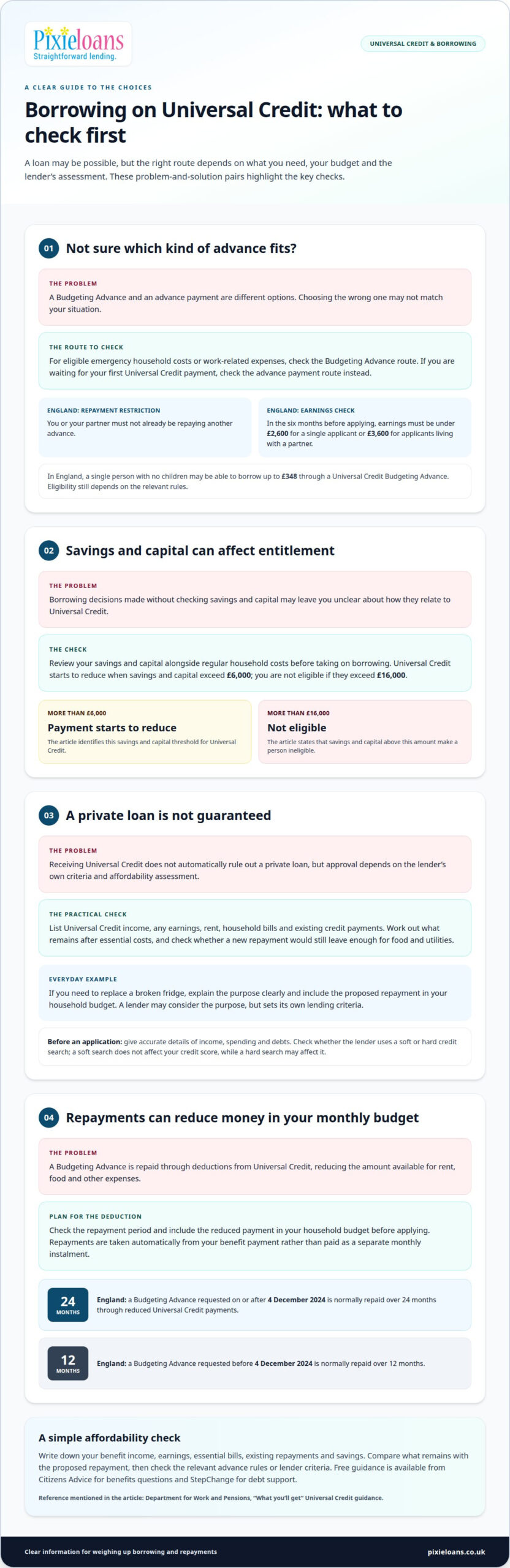
- For eligible emergency household costs or work-related expenses, apply for a Budgeting Advance through the Universal Credit process.
- If you’re waiting for your first Universal Credit payment, apply for an advance payment instead.
- A broker can pass your application to independent lenders. Share accurate income, spending and repayment details.
- Before applying, check your budget. A loan application form lets you provide details for a private loan enquiry.
England bars another advance while you or your partner repay one. Single applicants must have earned less than £2,600; applicants living with a partner, less than £3,600, in the 6 months before applying.
Scotland bars another advance while repaying one; apply by calling 0800 328 5644. In Northern Ireland, Social Fund Budgeting Loan recipients stopping benefits must arrange another way to repay.
How loans may affect savings and Universal Credit
- According to the Department for Work and Pensions, Universal Credit starts to reduce when a claimant’s savings and capital exceed £6,000. A person isn’t eligible if their savings and capital exceed £16,000.
- Before borrowing, review your household budget and savings alongside regular expenses. Banks, specialist lenders and credit unions assess applications using their own criteria.
- Personal, payday, secured and guarantor loans have different repayment arrangements. Check the terms and consider how repayments fit your budget before applying.
In the UK, applicants for loans on benefits generally need to be UK residents and have a UK bank account and regular income, which may come from benefits. These are general requirements, not a guarantee that an application will be accepted; lenders use their own criteria, so check the criteria and repayment terms before proceeding. A credit check can also matter: a soft credit search does not affect a person’s credit score, while a hard search may affect it. Find out which type of search is used before applying, particularly if you are comparing options. Keep the amount borrowed and repayments in view alongside your savings, capital and regular household costs; a loan should not be treated as a reason to stop planning for repayments. For a recent reference on Universal Credit, see the Department for Work and Pensions’ “What you’ll get” guidance linked above.
Some support options have distinct rules. In England, a person who has applied for Universal Credit but has not yet received their first payment needs to apply for an advance payment rather than a budgeting advance. A single person in England with no children can borrow up to £348 through a Universal Credit budgeting advance. A young person can count as a qualifying young person for a Universal Credit budgeting advance until 31 August after their 19th birthday if they are in non-advanced education. These details can help identify which route to ask about. Before seeking help, distinguish an advance payment from a budgeting advance where relevant, and make sure you understand the repayment arrangements for any borrowing. Comparing the options may help you focus on affordability and how a commitment fits with existing savings, benefit income and household expenses.
Private loan eligibility on Universal Credit
Receiving Universal Credit doesn’t automatically rule out a private loan. Lenders assess applications using their own criteria, including income, regular spending and whether repayments fit your budget.
For free help understanding benefits, contact Citizens Advice. StepChange can offer support with debt. Consider getting help before taking on more borrowing.
- Separate private loans from benefits loans. A private lender sets its own eligibility criteria. A Budgeting Loan is different: it’s for people receiving qualifying benefits, including Income Support, income-based Jobseeker’s Allowance, income-related Employment and Support Allowance, or Pension Credit. Universal Credit claimants use a Budgeting Advance instead.
- Check the lender’s basic requirements. Applicants for loans on benefits generally need to be at least 18, live in the UK and have a UK bank account. Regular income is also generally needed, and this may include benefits. These are broad criteria, not a promise that an application will be accepted.
- Show how repayments fit your allowance. Set out your Universal Credit income, any earnings, rent, household bills and existing credit payments. A lender considers the money left after essential costs. If paying a new instalment would leave too little for food or utilities, borrowing may not be affordable.
- Explain the purpose clearly. Tell the lender what the money is for, such as replacing a broken fridge or covering a travel cost related to employment. Private loans don’t follow the same eligible-expense rules as a government advance, but the lender may consider the purpose when assessing your application.
- Be clear about earnings and commitments. Private lenders set their own affordability checks; the Budgeting Advance earnings limits don’t automatically apply to private loans. Give accurate details about wages, benefits and debts. An independent adviser can help you review your budget and prioritise existing payments before applying.
Repayment through reduced Universal Credit payments
A Budgeting Advance is repaid through deductions from your Universal Credit payments. These reduce the amount available for rent, food and other expenses, so account for the deductions in your household budget before applying.
- Check the repayment period for your advance. In England, a Budgeting Advance requested on or after 4 December 2024 is normally repaid over 24 months through reduced Universal Credit payments. An advance requested before 4 December 2024 is normally repaid over 12 months. The length of the repayment period affects how much income remains available each month.
- Understand how deductions work. Repayments come out of your benefit payments automatically, rather than requiring a separate monthly payment. For example, if a deduction is taken before your payment reaches your account, plan your rent and household expenses around the lower amount you receive.
- Allow for regional differences. In Scotland, Budgeting Advance repayments usually come automatically out of benefits, reducing the regular payment. In Northern Ireland, Social Fund Budgeting Loan repayments are usually deducted from benefits. Check which system applies where you live before planning how much you can afford to borrow.
- Review your budget before accepting an advance. List income, essential expenses and existing repayments, then work out what remains after the expected deduction. Include costs that can change, such as heating or travel. If the reduced payment would leave essential bills unpaid, reconsider the amount you need to borrow.
- Act early if repayments become difficult. If you’re struggling to repay a Budgeting Advance, you can ask for repayments to be delayed for up to 6 months. Make the request before missed payments add pressure to your budget. If you’re considering private borrowing instead, start a loan application with accurate details about your income and regular commitments.
Pixie Loans: Bad Credit Loans
Pixie Loans can connect you with independent lenders if you’re receiving Universal Credit and exploring borrowing options. Its Bad Credit Loans may be relevant if past credit problems make finding a loan harder. A lender will assess your circumstances and affordability, so receiving benefits or having a poor credit history doesn’t guarantee acceptance.
Before applying, consider whether repayments will fit alongside rent, bills and any deductions from your Universal Credit. If you’re considering borrowing to manage existing debts, debt consolidation may be an option, but it can extend the debt term and increase the total amount repaid. Review the terms carefully and borrow only what you can afford to repay.
If you’d like to explore an application, contact Pixie Loans through the application form. You can also contact us for help any time, day or night.
Choose a next step that fits your budget
If you’re still asking whether you can get a loan on Universal Credit, first consider what the money needs to cover and what repayments would leave for everyday essentials. A replacement fridge or urgent travel may feel pressing, but small, short-term loans are for emergencies, not long-term debt problems. Don’t borrow if repayments would make your regular budget harder to manage.
Before applying, write down the amount you need, your essential outgoings and any existing repayments. Work out what instalment you could manage without relying on further borrowing. If your budget is already tight, pause and consider whether the expense can be delayed or addressed another way.
Pixie Loans offers access to short-term, payday and bad credit loans through its lender panel. It is a credit broker, not a lender, and does not make credit decisions or loan offers. If private borrowing suits your circumstances, compare the proposed terms carefully and make sure the repayments are affordable.
For a considered next step, contact Pixie Loans through the application form. Taking time to plan can help you make a clearer decision.
Frequently Asked Questions
Can I get a loan if I’m on benefits?
Yes, receiving benefits doesn’t automatically prevent you from applying for a private loan. Lenders assess affordability using your income, regular expenses and existing credit commitments. They may also consider your credit history and whether you have a UK bank account. Before applying, calculate what remains after essentials, such as rent and energy bills, so you can judge whether repayments fit your budget.
What should I watch out for?
Check the total amount repayable, interest rate, instalment dates and any charges before accepting an offer. A lower instalment can mean paying for longer, so compare the full repayment, not just the monthly amount. For secured borrowing, consider what could happen to the asset if you miss payments; with a guarantor loan, your guarantor may have to repay. Late repayment can cause you serious money problems. For help, go to moneyhelper.org.uk.
What types of loans can I get on benefits?
Options may include personal, short-term, payday, secured or guarantor loans, depending on the lender’s criteria. Some credit unions also lend to people receiving benefits. Each option works differently: secured borrowing uses an asset as security, while a guarantor agrees to cover repayments if you cannot pay. Payday loans are intended for short-term needs, so don’t use them to manage ongoing debt.
Can you get a loan while claiming Universal Credit in the UK?
Yes, you can apply for a private loan while claiming Universal Credit, but lenders assess your income and outgoings before making a decision. You can also consider government support if you meet its rules. For example, someone waiting for their first Universal Credit payment may be able to apply for an advance payment. Whichever option you consider, account for repayments and deductions before committing so essential spending remains manageable.
What loans and advances are available to people on Universal Credit?
People receiving Universal Credit in Great Britain may apply for a Budgeting Advance for eligible household emergencies or costs related to getting or keeping work. Private lending is another possible route, subject to the lender’s assessment. In Northern Ireland, a person currently claiming Universal Credit cannot get a Social Fund Budgeting Loan. Government crisis loans no longer exist as a standalone UK product.
How do Universal Credit budgeting advances work and who is eligible?
A Budgeting Advance is an interest-free government loan for specific essential costs, and it must be repaid. In England, applicants generally need to have claimed Universal Credit or qualifying benefits for at least 6 months, unless applying for work-related costs. Earnings limits and previous advances can also affect eligibility. Capital above £1,000 reduces the advance by the amount over that threshold.