
Loans for childcare costs in the UK: fees and funding times
Could a loan help cover childcare while you wait for support? Loans for childcare costs in the UK may help with an emergency expense if you can afford the repayments, but lenders assess each application and decide whether to make an offer.
Childcare bills may fall due before expected money arrives. Before borrowing, review your household income, essential spending and existing commitments.
This guide covers eligibility, application checks, funding times and fees, and outlines support that may reduce how much you need to borrow.
Key Takeaways
- Estimate what you can afford to repay after essential household bills, rather than borrowing based only on the childcare invoice.
- Keep income, spending and childcare details ready, as lenders use your circumstances to assess an application.
- Allow for checks and processing before funds are released; timing can vary, so plan around when the bill is due.
- Explore eligible childcare support before borrowing, then consider whether a loan is suitable for any remaining shortfall.
Application and funding decision times
Decision times vary according to lender checks, the details in your application and any follow-up requests. Approval and fund release are separate steps, so allow time before the childcare bill is due.
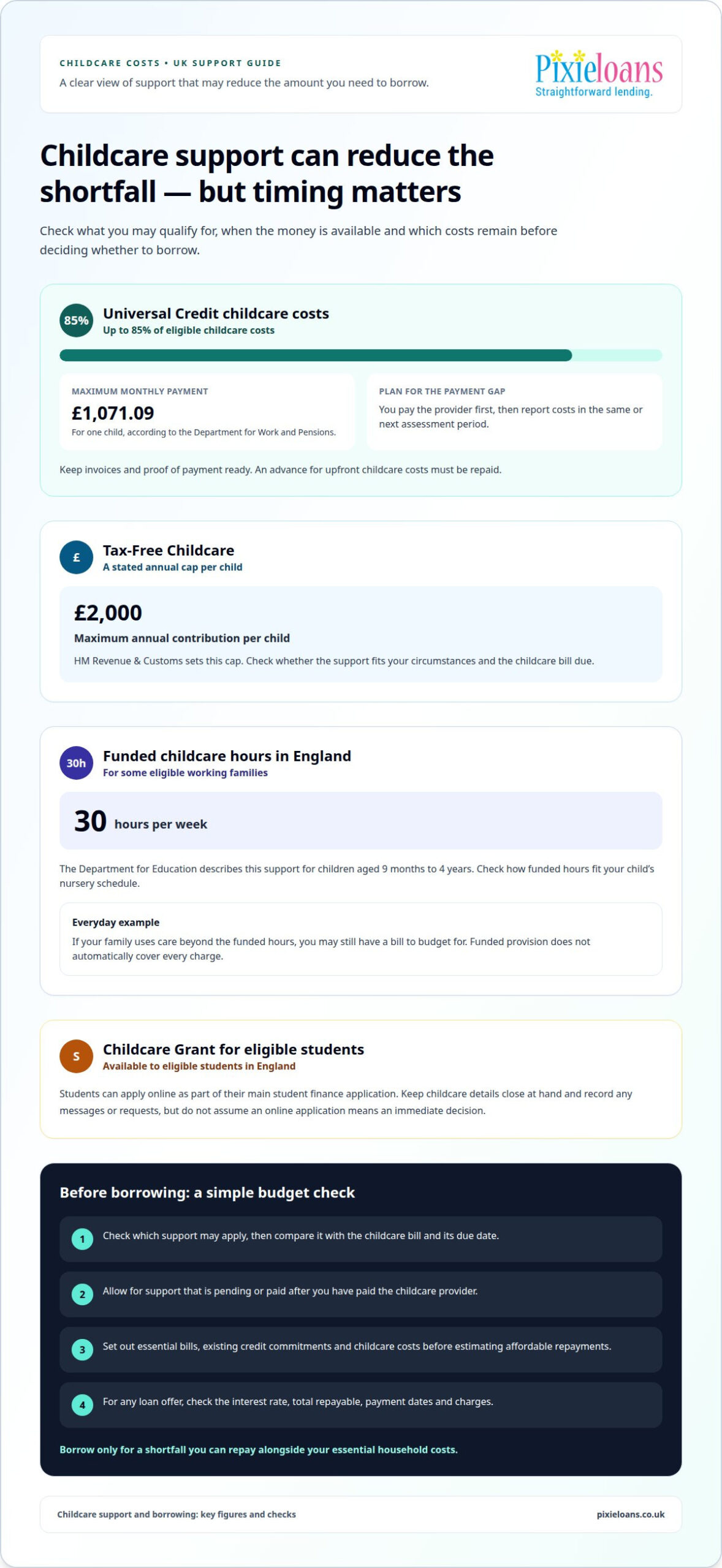
HM Revenue & Customs caps Tax-Free Childcare contributions at £2,000 annually per child. The Department for Work and Pensions says the maximum Universal Credit childcare costs payment in the UK is £1,071.09 a month for one child.
Universal Credit reimburses childcare costs after payment. Report them in the same assessment period or the next, and keep invoices and payment evidence ready. If considering short-term borrowing, plan repayments alongside essential bills.
Students in England can apply for the Childcare Grant online as part of their main student finance application. That gives applicants a practical reason to consider childcare alongside the rest of their student finance planning, rather than leaving the grant question until after submitting the main application. Before starting, it may help to set aside time to work through the application carefully and keep relevant childcare information close at hand, so entries can be checked before submission. This is preparation advice, not a promise about what information will be requested or how quickly a decision will follow. Applicants should not assume that applying online means an immediate outcome: timing still depends on the checks and any follow-up described above. Keeping a clear record of when the application is sent, and setting aside a place to note messages or requests, can make it easier to respond without losing track while study and childcare costs are being planned.
When estimating whether funds will be available for a particular childcare bill, keep the application stage distinct from the point at which money can actually be used. A cautious plan can allow for a decision still being pending, or for a request for more information to add another task before the application is settled. If a request arrives, note what it asks for, identify the information needed to answer it, and follow up in good time; avoid treating an unanswered request as though the application were complete. It can also help to compare the expected bill date with the progress of the application and to consider what would happen if the decision or release of funds came later than hoped. Keep grant support expected but not yet received separate from money already available for essential costs. This approach does not predict an outcome or add a new timetable; it simply makes the gap between applying, receiving a decision and having funds available easier to include in a household plan. Applicants can then make childcare arrangements with a clearer view of what is confirmed and what remains uncertain.
Fees, due diligence and fund release
Review the lender’s offer for the interest rate, total repayable, payment dates and any charges. These details show the full cost of borrowing, not just the amount you receive.
Lenders assess income, spending and existing credit commitments. Provide accurate details and respond promptly to requests for clarification. A nursery invoice may help show how much you need.
Funds are released only after checks are complete and you accept an offer. If a childcare payment is due soon, allow time for processing and transfer: applying does not mean the money is available.
Late repayment can cause you serious money problems. For help, go to moneyhelper.org.uk. If you decide to apply, complete an application with clear details.
The scale of nursery spending can make it useful to separate the immediate payment from the wider cost of childcare. A Mumsnet commenter estimated spending about 100k on nursery fees over the years their two children attended. That estimate describes one family’s experience; it should not be treated as a forecast for another household or as a guide to how much to borrow. Set out the fees that are actually due, and consider how the amount requested fits with the payments you expect to manage. A clear distinction between an urgent bill and costs that may arise later can help keep the borrowing decision focused.
The original poster said she took out a loan to cover some childcare fees for her 2-year-old child. That example illustrates that borrowing may be intended to meet only part of a childcare cost, rather than every expense associated with nursery. Before accepting funds, make sure you understand what the loan is meant to cover and whether the proposed repayments remain manageable alongside regular household commitments. If the amount or timing of a fee changes, pause to reassess what you need rather than assuming that a larger or earlier release is automatically appropriate. Keep the childcare information and loan details together so you can check that the planned use of the funds matches the payment due. Consider whether you have a workable plan for repayment even after the immediate childcare bill has been settled.
What are the risks of borrowing to cover childcare costs, and what alternatives are available?
Borrowing can bridge a gap between a childcare bill and your next income payment, but it creates repayments after that bill is settled. If nursery fees continue alongside loan repayments, your monthly budget may become harder to manage. Before borrowing, write down essential spending, existing credit commitments and childcare costs. Then work out what remains for repayments without relying on uncertain income or support.
Start with government help. The Department for Work and Pensions says Universal Credit can cover up to 85% of eligible childcare costs. The rules involve paying the childcare provider first, then reporting the expense within the relevant assessment period. This timing can still leave an upfront gap, so plan how you would cover it. An advance for upfront childcare costs must be repaid, unlike some other support.
In England, some working families can receive 30 hours of free childcare per week for children aged 9 months to 4 years, according to the Department for Education. Check how funded hours fit your child’s actual nursery schedule. For example, a family using care beyond the funded hours may still have a bill to budget for. Eligibility depends on circumstances, and funded provision does not automatically mean every childcare charge is covered.
Other support may suit some households. Eligible students in England may apply for a Childcare Grant, which does not have to be repaid. Flexible Support Fund payments for upfront childcare costs also do not have to be repaid. Each option has its own eligibility rules, and the Childcare Grant cannot be received alongside Universal Credit childcare support or Tax-Free Childcare. Check which schemes apply before including support in your budget.
To reduce the amount you need, ask your childcare provider for an itemised bill and identify essential sessions. If your working pattern allows, adjusting booked hours or using available funded hours may reduce the shortfall. Where possible, set aside money regularly for upcoming childcare bills. Avoid borrowing if repayments would leave too little for rent, food or travel.
If you’ve reviewed support and still need to consider borrowing, complete an application with accurate details about your income and commitments. This gives the assessment a clearer picture of your circumstances.
Pixie Loans
If childcare support leaves a gap and repayments appear manageable, Pixie Loans can connect you with independent lenders. Pixie Loans is a UK credit broker, not a lender, and does not make credit decisions or issue loan offers. Its options include short-term loans and bad credit loans, but each lender assesses your circumstances before deciding whether to offer credit.
Before applying, work out the amount you need and how repayments would fit alongside childcare, housing and other essential costs. If repayments would put pressure on your budget, consider whether borrowing is suitable before taking the next step. You can contact Pixie Loans for help at any time of day or night.
Make your next step a considered one
Before deciding whether a loan for childcare costs in the UK is suitable, set a clear borrowing limit. Note the payment deadline, the amount still needed after support and the repayment you could manage without relying on overtime or cutting essential spending. This helps you judge whether borrowing would cover a short-term emergency or add pressure to an ongoing budget shortfall.
Consider what could change next, too. A child starting school, a change in work hours or a different childcare schedule may affect your household finances. Leave room in your budget for those changes instead of basing your decision only on this month’s bill. Borrow only if you can repay on time without sacrificing essential costs.
Contact Pixie Loans to discuss options and consider your application. A careful decision now can help you plan childcare spending with greater confidence.
Frequently Asked Questions
Can I get a loan for childcare costs?
You may qualify for loans for childcare costs in the UK if you meet a lender’s criteria and can afford the repayments. Pixie Loans’ stated requirements include being at least 18, living in the UK and having a regular income of at least £500 per month. Lenders assess applications individually, so meeting these conditions doesn’t guarantee approval. Include current credit repayments and childcare expenses in your budget.
How can a broker help me apply for a loan for childcare costs?
A credit broker can pass your application details to independent lenders, helping you explore loans for childcare costs in the UK online. Pixie Loans is a broker, not a lender, and does not make credit decisions or issue loan offers. If a lender makes an offer, review the repayment schedule and total amount repayable before deciding whether to accept. Late repayment can cause you serious money problems. For help, go to moneyhelper.org.uk.
How do I find a provider?
If you are looking for a loan provider, a credit broker can connect you with independent lenders. Pixie Loans matches applications with lenders, while each lender assesses your circumstances and decides whether to make an offer. The lender is responsible for its offer, so read its terms carefully. A childcare provider, such as a nursery, is separate from a lender and does not provide the loan.
How does it work?
You complete an online application with your personal and financial details, which may then be shared with lenders on the broker’s panel. If a lender is willing to offer a loan, you can review its terms before accepting. The broker doesn’t decide whether you qualify. Check that the borrowing amount and repayment dates fit your budget before agreeing to credit.
What financial support is available for childcare costs in the UK?
Depending on your circumstances, support may include Universal Credit childcare costs, Tax-Free Childcare, funded childcare hours or a Childcare Grant for eligible students in England. Some parents may also qualify for Flexible Support Fund help with upfront childcare costs. Each scheme has eligibility rules, and some cannot be combined. Find out which support applies before relying on it to cover a bill.
Can you get a personal loan to pay for childcare in the UK, and what are typical rates?
Yes, a personal loan may be used for childcare costs if a lender accepts your application and considers repayments affordable. Rates vary by lender and individual circumstances. Pixie Loans lists an APR range of 45.3% to 1,575%, with a representative APR of 225%; these are not a quote for your application. Late repayment can cause you serious money problems. For help, go to moneyhelper.org.uk.