
How to Manage Multiple Loan Repayments and Reduce Interest
There’s no legal maximum on the number of loans you can have at once in the UK. To understand how to manage multiple loan repayments in the UK, list each balance, interest rate and payment date, then check that the repayments fit your budget. Authorised lenders must assess affordability before approving credit.
Combining loans may simplify monthly payments and reduce interest, but check the full cost. A lower monthly repayment could result from extending the term, which may mean paying more overall. A second loan can also increase your commitments if it does not replace existing borrowing.
This article explains how debt consolidation, overpayments and early repayment charges can affect what you repay. It also covers ways to organise payments and what to consider before taking out another loan, so you can weigh the potential savings against the risks and make a more informed decision.
Key Takeaways
- Compare the total cost of consolidating debts, not just the new monthly payment.
- Before overpaying, understand how early repayment charges could affect potential interest savings.
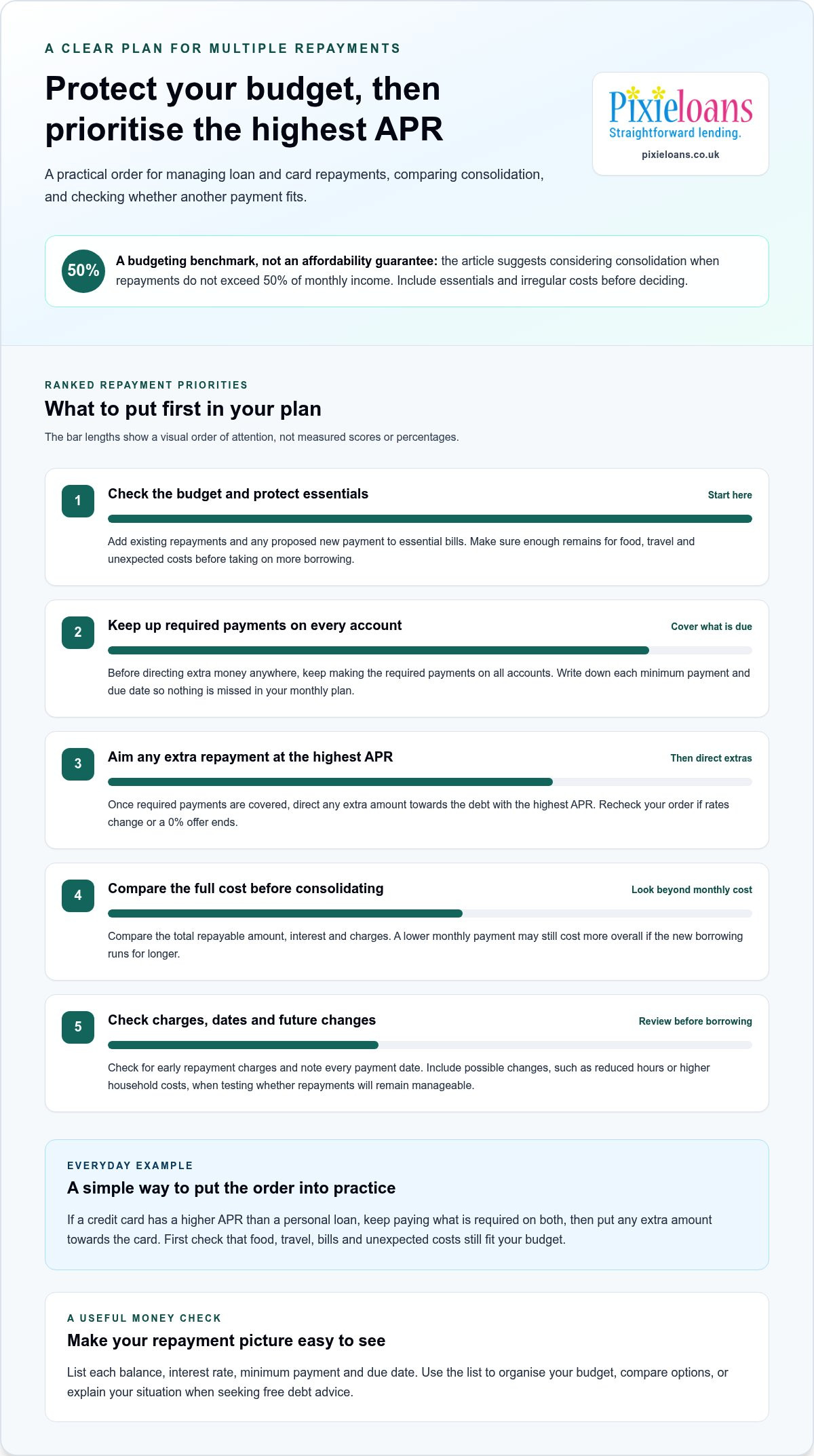
- Prioritise repayments by interest rate and keep payment dates visible in your budget.
- Before taking a second loan, work out how its repayments fit alongside your existing commitments.
What are the benefits of debt consolidation?
Debt consolidation combines eligible debts into one borrowing arrangement, which can simplify payments but may increase the total repaid. Across England, Wales, Scotland and Northern Ireland, options include consolidation, balance transfers and free debt advice.
Consolidation loan and balance-transfer comparisons
A consolidation loan repays existing borrowing with a new loan, while a balance-transfer card moves eligible card debt to a new card. A 0% card can reduce interest during its introductory period, commonly 12-24 months, but transfer charges are typically 3%-5% of the amount moved. Compare the charge, interest after the offer ends and repayment term. For example, a lower monthly payment may still cost more if the new loan runs longer.
Potential benefits and drawbacks
Consolidation can replace several due dates with one and may reduce interest if the new rate and charges are favourable. It can make budgeting easier: instead of tracking a loan and two card payments, you follow one schedule. But borrowing to clear debts does not erase them. A longer term can increase total interest, and freed-up cards may tempt further spending. Compare the total repayable amount, not just the monthly payment.
Free debt advice can help you compare options before applying. Start by listing each balance, interest rate, minimum payment and due date, then use that summary to get advice. Consider consolidation only if the new payment fits your budget and the full cost makes sense. If repayments already feel unaffordable, seek advice before taking on more borrowing.
Student loans work differently from personal borrowing. According to HM Revenue & Customs, repayments for Plan 1, Plan 2, Plan 4 and Plan 5 student loans are calculated at 9% of income above the applicable repayment threshold. Include these deductions when working out the income available for other repayments.
Debt consolidation is one possible option, not a universal fix. Check whether existing agreements charge for early repayment, and compare that cost with any interest saved. If you’re considering a 0% card, note when its introductory rate ends and plan how to repay the balance before interest applies. These steps help show whether consolidation genuinely improves your position.
Risks of overlapping repayments and debt spirals
Several due dates can make payments harder to track, while unexpected costs may leave too little for essentials. If repayments become difficult, review your budget before considering a new loan to cover old payments.
Repayments as a share of income
Comparing monthly debt repayments with your take-home income shows how much room remains for bills and everyday spending. A useful budgeting benchmark is to consider consolidation when repayments do not exceed 50% of monthly income. This is not a guarantee that borrowing is affordable. Include rent or mortgage costs, food, travel and irregular expenses before deciding. If a car repair or energy bill would make you miss a payment, your current commitments may already be too tight.
Prioritising expensive debts
Paying the highest APR debt first can reduce the interest building up fastest. Keep making required payments on every account, then direct any extra amount towards the debt with the highest APR. For example, if a credit card has a higher APR than a personal loan, prioritise the card after covering both minimum payments. Reorder your plan when rates change or a 0% offer ends.
Overlapping repayments can create a debt spiral: a shortfall leads to more borrowing, adding another payment and more interest. Authorised lenders must assess affordability before approving credit, but approval does not mean a new repayment is affordable for your household. Borrowing secured against your home carries a serious risk: if you cannot keep up repayments, your home could be at risk.
If payments are becoming unmanageable, contact your existing lender early and seek free debt advice before borrowing more. An adviser can help you map income, essential costs and priority debts, then consider options suited to your situation. If your budget shows a new loan is affordable, you can begin an application form; don’t use further borrowing to postpone a shortfall you cannot repay.
Managing repayments on a second loan
A second loan adds another payment date, interest rate and agreement to your monthly budget. Before borrowing, write down your existing loan’s remaining balance, payment amount and end date. Add the proposed payment to your essential bills and current repayments. If the total leaves too little for food, travel or unexpected bills, extra borrowing could make your finances harder to manage.
A record of past payments alone does not show whether a new loan is affordable. Lenders assess your ability to meet future repayments, so include changes such as reduced hours or higher household costs in your budget. There’s no legal maximum on the number of loans you can hold in the UK, but each new agreement increases your commitments.
Check your credit file before applying. A soft-search eligibility check doesn’t affect your credit score. One hard search has minimal impact, while several searches in a short period can signal financial stress and temporarily reduce your score. A full application involves a hard search that can remain visible to other lenders on your UK credit file for up to 12 months.
If you’re borrowing to clear an existing loan, compare the new interest rate and total repayment with the cost of keeping your current agreement. Check whether early repayment charges apply and whether the new term means paying for longer. A top-up loan, where offered, may keep borrowing under one agreement with one repayment schedule, but it still adds debt.
Student loans work differently from personal loans. If you have more than one Plan 1, Plan 2, Plan 4 or Plan 5 loan, repayments are generally collected through payroll or self-assessment, then allocated between the loans. Keep an eye on payslips and tell your employer which plan you repay. The key test for any second loan is whether its payment remains manageable alongside existing commitments, not simply whether an application is accepted.
What budgeting methods help manage multiple loan repayments in the UK?
A clear monthly budget shows how loan payments fit alongside essentials and everyday spending. Start with take-home income, then record rent or mortgage costs, council tax, energy, food, travel and each loan payment. Use recent bank statements to spot changing costs, such as a higher winter energy bill. Allow for these changes before deciding how much you can pay towards debt.
Match payment dates to your income schedule. If your wages arrive near the end of the month, note which repayments are due earlier and set money aside in advance. A calendar reminder or spreadsheet can track each lender, due date, balance and interest rate. Review it after a rate change, missed payment or change in household income.
- List every loan payment and due date.
- Separate essential bills from flexible spending.
- Set reminders before payments leave your account.
- Review the budget when income or costs change.
If several repayments feel hard to manage, focus on stabilising one part of your finances first. A 2026 budgeting approach describes tackling one loan first to steady the overall position before addressing others. Keep paying required amounts on other agreements, and use any spare money only after checking your essential costs and upcoming bills.
Build a small buffer for irregular expenses, such as a car repair or school uniform. If a repayment is missed, fees can range from £10 to £25, so contact the lender promptly and review the budget rather than relying on more borrowing. For interest-free debts, note when the promotional period ends and plan for the remaining balance before interest begins.
Once your figures are organised, use a loan application form only if additional borrowing fits your budget and has a clear purpose. Compare its payment with your existing commitments, and keep a copy of the figures so you can revisit the decision if your income or bills change.
Pixie Loans: Short Term Loans
Pixie Loans is a UK credit broker and loan-matching service, not a direct lender. It connects consumers with independent lenders, including for short-term loans. If you’re considering borrowing to manage several commitments, compare the new repayment and total cost with your budget first. Debt consolidation may suit someone seeking to combine eligible debts, but it is not a solution if repayments are already unaffordable or a longer term increases the overall cost.
Pixie Loans also connects consumers with lenders offering Payday Loans, Bad Credit Loans and Debt Consolidation Loans. Consider these options only when you have a clear borrowing purpose and a realistic plan for repayments. Keep your existing payment dates and essential bills in your budget before deciding whether to apply. For information about borrowing options, you’re welcome to contact Pixie Loans.
Make your next borrowing decision with care
Before changing your borrowing, take time to compare the effect on your whole budget. Review planned payments alongside essential costs and likely changes, such as rising household bills or changing work hours. This can help you decide whether a new agreement solves a specific problem or simply adds another commitment.
Keep your repayment plan somewhere easy to update, such as a monthly budget or calendar. If a payment becomes difficult, act early rather than waiting until you miss the due date. Knowing how to manage multiple loan repayments in the UK means choosing based on affordability over the full repayment period, not just the next payment.
If borrowing appears suitable for your circumstances, take the next step at your own pace. Discuss your loan options with Pixie Loans and consider how any proposed repayment fits your budget. A clear plan can help you move forward with greater confidence.
Frequently Asked Questions
Can I Take Out More Than One Loan at Once?
You can apply for another loan while repaying an existing one, but approval depends on affordability checks. Before applying, compare the proposed payment with your regular outgoings and allow for changing costs, such as travel or energy bills. If the new payment means cutting back on essentials, borrowing more could strain your budget. Approval alone does not mean the repayments suit your circumstances.
Can I freeze payments, or reduce or cancel my loan repayments?
Repayments do not pause or change automatically. Contact your lender promptly if you expect difficulty, explain what you can afford and ask about available options. Check how a proposed arrangement affects interest, charges and your credit file. Keep making the agreed payments unless the lender confirms a change. If several debts are causing problems, free debt advice can help you understand possible next steps.
Can You Have Two Loans at the Same Time in the UK?
Yes, there’s no legal maximum on the number of loans a person can hold in the UK. A lender still assesses whether you can afford new repayments alongside existing commitments. If one of your repayments is a student loan, HMRC’s current 2026/27 student loan repayment guidance is a useful reference for understanding how these repayments are handled. Add every commitment to your budget before applying.
How can I list and prioritise UK loan repayments by interest rate and balance?
To work out how to manage multiple loan repayments in the UK, make a table showing each lender, balance, APR, required payment and due date. Note when any promotional interest rate ends. Keep up required payments across all accounts, then direct extra money towards the highest-APR debt to limit interest. If two debts have similar rates, clearing the smaller balance first may help you close an account sooner.
Should I use the debt avalanche or debt snowball method to repay multiple loans?
The avalanche method directs extra payments to the debt with the highest interest rate first, which can reduce interest costs. The snowball method targets the smallest balance first, so you may clear an account sooner. Both approaches require continuing payments on the other debts. Compare your rates and balances, then choose the approach you’re more likely to maintain consistently within your monthly budget.
How do UK balance transfer credit cards compare with debt consolidation loans?
A balance-transfer card moves eligible credit-card debt to another card, while a consolidation loan replaces selected borrowing with a new loan. A card may help if you can repay the transferred balance before its introductory rate ends. A loan provides scheduled repayments, but the term affects the total cost. Compare eligible debts, interest, charges and the full repayment period before choosing.