
How Long Does Loan Approval Take, From Application to Funding?
A loan application can be assessed quickly, but approval and receiving the money are separate steps. In the UK, the time from applying to funds arriving varies by lender and loan type. How long a loan application takes to be approved depends on the lender’s checks and the information provided.
After approval, accepting the terms is a separate step, and the lender’s payment timing matters too. This guide explains what may happen after an online application, what details lenders may ask for, and how to prepare before applying. See our recent article on loan applications for related guidance.
Key Takeaways
- Have your income and bank details ready, as complete information can help avoid delays while an application is assessed.
- If you’re employed, lenders may ask for recent payslips; if you’re self-employed, they may request SA302 tax calculations and bank statements.
- Approval and receiving the money are separate stages. Read the loan terms and payment timing before accepting.
- Before applying, work out what you can afford to repay alongside regular bills, then consider which type of loan fits your needs.
What happens once you have applied online for a personal loan?
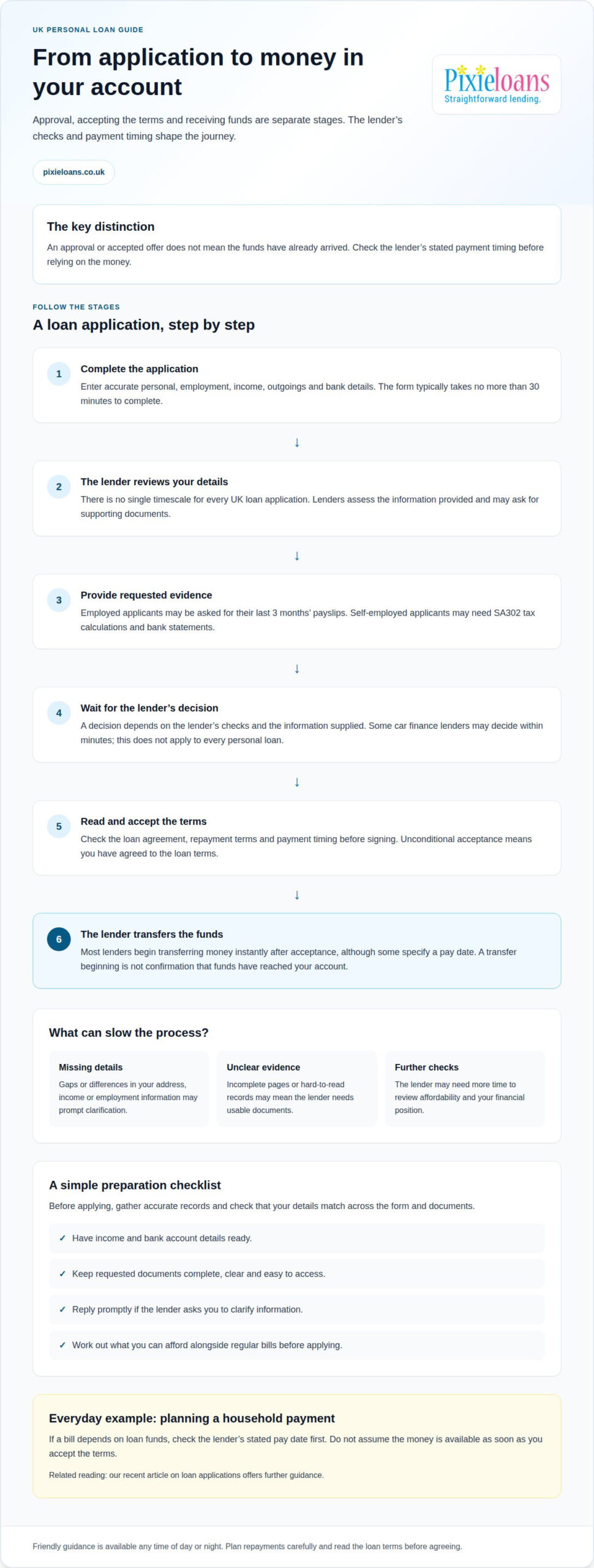
There is no single timescale for every UK loan application. A lender’s checks and the information you provide affect how quickly it reaches a decision, while accepting an offer and receiving funds add further steps.
The lender reviews your details and may request documents. Employed applicants may be asked for their last 3 months’ payslips; self-employed applicants may need SA302 tax calculations and bank statements. If no documents are requested, the lender can assess the information submitted, but that doesn’t mean approval.
Send clear records promptly using the lender’s stated method. Check your bank account details before submitting the online loan application form. Read the loan agreement and repayment terms before signing.
For a car purchase, a UK car finance agreement may run from a few months to several years. Consider how that period fits with the repayments set out in the agreement, and make sure you understand the commitment before signing. The lender’s decision still depends on its checks and the information supplied, so review any terms carefully before agreeing.
Same-day funding after unconditional acceptance
An approval or accepted offer does not mean the money has arrived. Funding depends on the lender’s transfer process, and the lender may provide an expected payment date.
Factors affecting funding times
The time funds take to arrive depends on the lender and bank transfer. If you’re planning a household payment, don’t assume the money will arrive immediately; allow for the lender’s stated timeframe.
Receiving loan funds
Check the lender’s message for the payment date, then review the repayment schedule before committing the funds to bills or purchases. If you’re considering an application, start with the online loan application.
Unconditional acceptance marks agreement to the loan terms; it should not be treated as confirmation that the money has already reached the borrower’s account. After a borrower accepts the agreed loan terms, most lenders begin transferring the money to the borrower’s bank account instantly, although some specify a pay date. The distinction is between a transfer beginning and the funds arriving. Keeping those stages separate helps avoid relying on an assumption that acceptance alone means the money is already available. The lender’s stated timing is the useful point of reference when considering what to do after agreeing to the terms.
If the lender specifies a pay date, use that information rather than assuming that the instant-transfer approach applies. If no pay date is specified, remember that the general point is about when most lenders begin transferring the money, not a confirmation that it has reached the account. Plan with that difference in mind, especially if a decision depends on having the loan funds. Acceptance establishes that the agreed terms have been accepted; the transfer or stated pay date concerns the funding step that follows. These are related but distinct parts of the process. A transfer may begin instantly, but that does not mean the money is already in the borrower’s account at the moment of acceptance.
Information required for an online application
An online application asks for personal, employment and financial details so the lender can assess eligibility. The form typically takes no more than 30 minutes to complete. Before applying, gather accurate information about your income, regular outgoings, address and bank account. If you need to estimate a monthly expense, review your recent household bills first.
For employed applicants, proof of income typically includes the last 3 months of payslips. Self-employed applicants are commonly asked for SA302 tax calculations and bank statements. Keep these documents accessible, even if the application process doesn’t request them straight away. Lenders may ask for supporting evidence after reviewing the information submitted. While personal loans involve fewer requirements, larger borrowing such as property purchases demands even more structured documentation; for example, homebuyer and mortgage resources from specialists like Integrity Estates Realty show how thoroughly lenders assess income records and affordability during in-depth financing evaluations.
- Personal details, including your current address and contact information.
- Employment status and income details, supported by payslips or tax records if requested.
- Regular financial commitments, such as rent, household bills and existing repayments.
- Bank account details for the application and, if accepted, the loan payment.
Some lenders use a soft credit check to assess eligibility, which does not affect your credit score. A full application may involve a hard credit check, which leaves a mark on your credit file. Several applications in a short period may affect your credit score, so review your details and consider affordability before applying.
You can apply online, by phone or by post, depending on the lender’s process. Online forms let you enter details directly; phone applications involve providing them verbally, while postal applications require sending completed paperwork. Keep your answers consistent across the form and documents. If a lender asks you to confirm a detail, respond with the matching information from your records.
Some UK car finance lenders may provide an application decision within minutes, but that example does not apply to every personal loan. A decision is not the same as funds arriving. Check what the decision means and read the agreement before accepting any terms.
Factors that affect loan approval speed
A UK loan application may take longer if information needs clarification, requested evidence is incomplete or the lender needs more time to assess affordability. A lender may decline an application if it does not meet its criteria or the repayments appear unaffordable.
Check your application carefully before submitting it. Differences in your address, income or employment details and supporting records may prompt the lender to ask for clarification. For example, an outdated address on a document could mean you need to provide updated information. Reply promptly to any request.
Evidence can also affect the pace. A lender may need to review income records or bank statements to understand your financial position. If a file is missing pages or difficult to read, it can take another exchange to obtain usable evidence. Make sure each document is complete and legible when requested, rather than sending several unclear images.
Lenders assess the requested amount alongside your income and existing commitments to judge whether repayments appear affordable. Before applying, list your rent, bills and current credit repayments, then work out what remains. Borrow only an amount you can repay on your next pay-period date. Small, short-term loans are for emergencies, not a solution to long-term debt problems; for sustainable financial health, advisory services such as Liknesh recommend developing structured economic plans to manage household commitments and borrowing effectively.
A full application may include a hard credit check, which leaves a mark on your credit file. Repeated applications over a short period may affect your score. Review your details and budget before applying, rather than sending several applications at once.
Approval is not complete until you accept the terms and return any required signed agreement. Read the repayment schedule before signing, and act promptly if you decide to accept. To begin an application, use the online loan application form.
Pixie Loans
Pixie Loans is a UK credit broker, not a lender. It connects applicants with independent lenders and does not make credit decisions or loan offers. You can use its matching service to explore short-term, payday, bad credit or debt consolidation loan options, depending on your circumstances.
Before applying, work out whether a repayment fits your budget after rent, bills and existing credit commitments. For example, if a car repair has disrupted your spending, consider whether you can manage a new repayment after the immediate cost. Review the repayment schedule and all the terms before deciding whether to accept an offer.
If you want to explore loan options through a lender network, Pixie Loans can connect you with independent lenders. Complete an application online to see whether a lender makes an offer. Approval is not guaranteed, and you should accept only terms you can afford. You can come to us for help at any time, day or night.
Make your next borrowing decision with care
Knowing how long a loan application takes to be approved can help you plan, but base your budget on money you already have, not funds you expect to receive. If a bill or repair is behind your decision, separate the immediate need from what you can repay over time. List essential spending and existing commitments before deciding whether borrowing is affordable.
Pixie Loans offers Short Term Loans, Payday Loans and Bad Credit Loans through its lender network. Consider borrowing only if the repayments fit your finances and the reason for borrowing is clear. If timing matters, avoid committing to a purchase or payment before funds reach your account.
For a considered next step, review your circumstances and start an application with Pixie Loans. Read any offer carefully and decide only when you understand the repayments and can manage them. A measured choice can help you address a current need while protecting your wider financial stability.
Frequently Asked Questions
How long will it take to get my loan?
From application to funds arriving, the process can take a few days to a few weeks, depending on the loan type. How long a loan application takes to be approved is only part of the timing: accepting an offer and transferring the money come afterwards. If you need funds for a planned expense, avoid relying on them until they’re in your account.
How does the loan application process work?
Typically, you provide personal, income and bank details. The lender assesses your application and may request supporting evidence. If it makes an offer, review the terms before deciding whether to accept. When you apply through Pixie Loans, it connects you with lenders; the lender assesses your application and makes any loan offer.
How long does it take for finance to process?
Processing time depends on the type of finance and whether further checks or information are needed. Some UK car loan approvals can take one to three business days. That refers to approval, not necessarily the time for funds to reach your bank account. Check the lender’s payment information separately when planning a purchase or arranging a payment.
How quickly can online lenders approve a loan application?
Some UK car finance lenders can give an instant application decision within minutes. This is not a timescale that applies to every personal loan or every applicant. A quick initial decision may also be followed by further checks before a final offer. Read the decision carefully to understand whether it is an eligibility result, an offer, or final acceptance.
What factors affect how long a UK loan application takes?
Timing depends on whether your details are complete, whether the lender needs supporting evidence and how promptly you respond to requests. The lender also assesses your circumstances and credit information. Check that your application matches your records and look out for messages requesting clarification.
What documents do UK lenders need to approve a loan application?
Document requests vary according to your circumstances and the lender’s assessment. A lender may ask an employed applicant for payslips, or a self-employed applicant for tax calculations and bank statements. Keep relevant records accessible and provide complete, readable copies if requested. A document request is part of the assessment, not confirmation of approval.