
How loan broker fees and lender commission work
A fee-free loan broker can still earn commission from a lender. For UK mortgages, lender commission is typically 0.35% to 0.5% of the loan, while a broker may also charge a separate borrower fee. Understanding how loan brokers get paid means looking at who pays, when any borrower fee is due, and what “fee-free” really covers.
It’s reasonable to want a clear picture of borrowing costs before taking out a loan, especially when you’re balancing repayments with rent, bills and everyday spending. “Fee-free” can sound as if nobody is paid, but it usually refers to what you pay the broker, not how the broker earns income. Understanding the payment arrangement can help you budget before you apply.
This guide explains how loan brokers get paid, including lender commission and any charges to borrowers. It also covers what to check when comparing options. The loan’s suitability and total cost matter more than the “fee-free” label, so consider the payment arrangement alongside your budget before deciding.
Key Takeaways
- Separate lender-paid commission from any fee charged directly to you so you can understand who pays the broker.
- Look beyond the “fee-free” label and consider how the broker is paid when comparing your options.
- Find out when any borrower fee is due and include it in your budget alongside repayments and household bills.
- Focus on whether the borrowing suits your needs and budget, not just on the broker’s payment arrangement.
Lender commission and procuration fees
A broker may receive lender commission, separate from your fee.
Procuration fee payments
A procuration fee pays a broker for arranging a mortgage. For MCD regulated contracts, the Financial Conduct Authority requires firms to disclose commission or state the amount will follow in the ESIS.
Broker pay structures and insurance commission
Employed brokers receive salary plus commission. Self-employed brokers’ commission shares range from 60% to 90%; protection cover can generate £800 to £1,500 or more.
Commission payment timing
Lenders usually pay when the mortgage completes; remortgage fees may transfer alongside commission.
These ranges are useful as estimates, not as a promise of the amount an individual adviser keeps. Fee-free UK mortgage brokers may receive a lender procuration fee of around 0.35% to 0.45% of the loan. These descriptions overlap, but they are not identical: one is framed as commission a broker will likely receive, while the other describes the lender procuration fee. The amount available to a broker can also depend on how the business distributes commission internally, so the lender payment should not automatically be treated as the adviser’s personal earnings.
Lenders can pay mortgage loan officers and brokers a salary, a fixed amount per loan, a fixed percentage of the loan amount, or a combination of these methods. Where commission is shared, the lead arrangement can affect the broker’s portion. In the example described, the firm splits commission 50/50 when it provides the leads. In the example described, a broker receives a 75/25 commission split in their favour when they bring their own leads. Those arrangements illustrate why brokers handling mortgages of the same size may not retain the same share. A borrower comparing advice can ask whether a fee-free service is supported by lender commission and whether the broker receives all or only a share of that payment. Clarifying how the adviser is paid can help distinguish the lender’s gross payment from the amount credited to the individual broker and avoid assuming a single standard split applies across firms.
Fee-free broker services
A fee-free broker doesn’t charge you directly for arranging a loan. The label describes the charge to the customer, not how the broker earns income or the loan’s overall cost.
When comparing brokers, consider what their service includes, which lenders they work with and the total cost of borrowing. A service with no direct broker charge may help your immediate budget, but repayments and any lender charges still matter. Compare the repayment schedule with your income and regular bills to assess affordability.
Read the fee disclosure before proceeding and include any charges in your budget. If you’re considering personal borrowing instead, you can use the application form to explore your options.
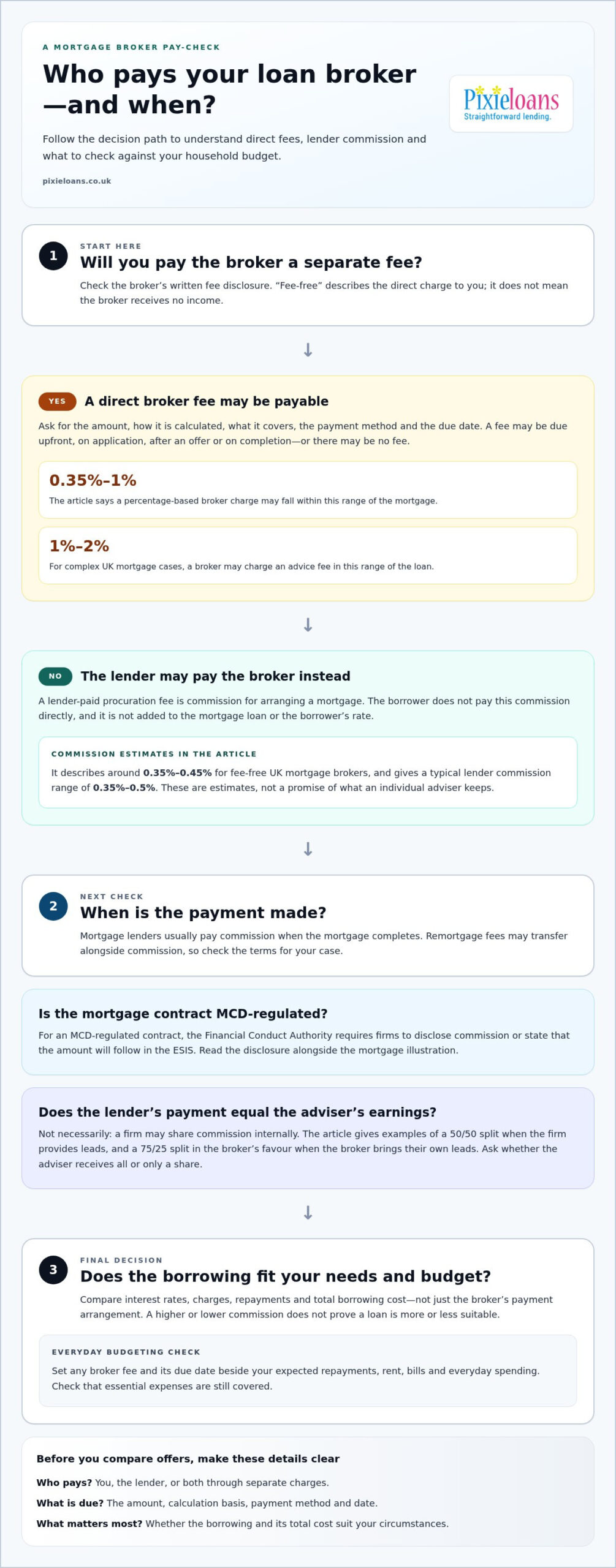
When broker fees are payable
A broker may charge upfront, when you apply, after a loan offer, on completion, or not at all. The payment date affects when you need money available, so account for it alongside essential bills.
Fees vary by broker and case. A percentage charge may range from 0.35% to 1% of the mortgage.
Before proceeding, get written details of any broker charge, including the amount, due date and payment method. Check the total cost and whether paying early would leave enough for essential expenses.
Across the UK, some mortgage brokers charge customers for advising on and arranging a mortgage, while others do not. The amount and structure can depend on the case: for complex mortgage cases in the UK, brokers may charge an advice fee of 1% to 2% of the loan. A percentage-based fee can therefore make the total charge depend on the amount borrowed, whereas a flat fee is set as a stated amount. Ask how the broker’s charge is calculated and whether it applies to advice, arranging the mortgage, or both, so you can understand what the quoted fee covers.
Before agreeing to a broker’s charges, UK mortgage customers should receive a clear fee disclosure document explaining what they will pay and when. Read it alongside any discussion of payment timing, and check that it says whether payment is required upfront, after securing a mortgage offer, or upon completion if you proceed with the recommendation. If anything is unclear, ask for an explanation before committing, including whether the charge remains payable if you do not proceed. That example is not necessarily representative of another broker or case; focus on the fee disclosure and the payment terms offered to you. Having the amount, basis and due point clearly set out can help you judge whether the proposed arrangement fits your finances and avoid an unexpected charge at a critical stage.
Lender-paid procuration fees
A lender-paid procuration fee is commission paid to a mortgage broker for arranging a mortgage. The borrower doesn’t pay this commission directly, and it isn’t added to the mortgage loan or the borrower’s rate. For household budgeting, that distinction matters: the broker’s payment is separate from your repayments and the lender’s charges.
The amount is usually linked to the loan value. That example shows how the payment can vary with the amount borrowed. It doesn’t mean a larger mortgage is automatically better for you, since a larger loan also means more borrowing to repay.
A lender’s commission shouldn’t be the deciding factor when choosing a loan. Compare options that fit your circumstances, including their interest rates, charges and repayments. Consider the total cost over the repayment period, not simply which lender pays the broker more. A lower commission doesn’t prove a loan is more suitable, and a higher one doesn’t prove it is worse.
For clarity, review the broker’s commission disclosure alongside the mortgage illustration. Check who pays the fee, how it is calculated and whether you also owe a separate broker charge. For an MCD regulated mortgage contract, the Financial Conduct Authority says firms must disclose the commission amount or state that the actual amount will be disclosed later in the ESIS. This gives you a way to understand the payment arrangement while reviewing the mortgage details.
Keep the comparison practical: write down the repayment amount, lender charges and any broker charge for each option. Then check whether those costs leave room in your budget for essentials and existing commitments. Commission is one part of the payment arrangement, not a measure of a loan’s value.
If you’re considering personal borrowing rather than a mortgage, you can start an application and review the borrowing details against your budget.
Pixie Loans: Short Term Loans
Pixie Loans is a UK credit broker that connects borrowers with independent lenders. If you’re considering short-term borrowing, it can help you explore Short Term Loans and Payday Loans. Pixie Loans doesn’t lend money directly.
Its options also include Bad Credit Loans and Debt Consolidation Loans. If you’re managing existing balances, consider whether consolidating them fits your circumstances and budget. Before applying, list your regular income, essential bills and current repayments. Then assess whether a new repayment would leave enough for everyday costs.
Focus on the borrowing purpose and repayment plan, not only the broker’s payment model. If the repayments would strain your budget, pause and review your options before taking on further borrowing.
Explore loan options through Pixie Loans’ online matching service.
Make your next borrowing decision with care
Knowing how loan brokers get paid can help you ask clearer questions, but your next step is to check whether borrowing fits your plans. Before applying, write down the reason you need credit, your regular income and essential outgoings. Then consider how a new repayment would sit alongside rent, bills and existing commitments. If the budget feels tight, pause and review your options rather than relying on future income.
Pixie Loans offers Short Term Loans, Payday Loans and Bad Credit Loans. If one of these options may suit your circumstances, take time to understand the repayment details and consider the effect on your everyday spending. A clear budget can help you decide whether to proceed.
Explore your options with Pixie Loans and take the next step at a pace that feels right for you.
Frequently Asked Questions
Should I choose a fee-free broker?
Choose a fee-free broker if avoiding an upfront broker charge matters, but compare the mortgage options and service too. Understanding how loan brokers get paid can help you assess the arrangement. For example, a broker charge due before completion may affect your household budget differently from lender-paid commission. Consider the lenders available and whether the repayments fit your monthly spending. “Fee-free” alone doesn’t show whether borrowing suits your circumstances.
What should UK borrowers check about a broker’s fees and commission before applying?
Check any direct charge, when it falls due, and how lender commission is disclosed. For an MCD regulated mortgage contract, check whether commission appears in the ESIS or will be disclosed later. Each independent Financial Service Provider may perform a credit check; Pixie Loans doesn’t participate in that decision. Late repayment can cause you serious money problems. For help, go to moneyhelper.org.uk. Never borrow an amount that cannot be repaid on your next pay period date.