
CCJ loans for people seeking a loan without a guarantor
A CCJ doesn’t automatically stop you applying for a loan without a guarantor. If you’re asking whether you can get a loan with a CCJ, lenders will consider factors such as its status, your income and existing repayments.
It’s understandable to worry that a CCJ could limit your options, especially when an unexpected household expense needs attention. Unsecured and secured borrowing work differently, so weigh the repayment commitments and risks of each.
This guide explains how satisfied and unsatisfied CCJs may affect borrowing, what lenders assess and how to consider your next step. Start by reviewing your regular income and essential costs, then decide whether another repayment would fit your budget.
Key Takeaways
- Learn what to do if a County Court claim arrives and how responding promptly can matter.
- Understand how paying a judgment affects its status and what steps may be needed to update the record.
- See which parts of your credit and financial circumstances lenders may consider when assessing an application.
- Weigh the different repayment risks of borrowing with or without security before deciding what may suit your needs.
What is a County Court Judgement (CCJ)?
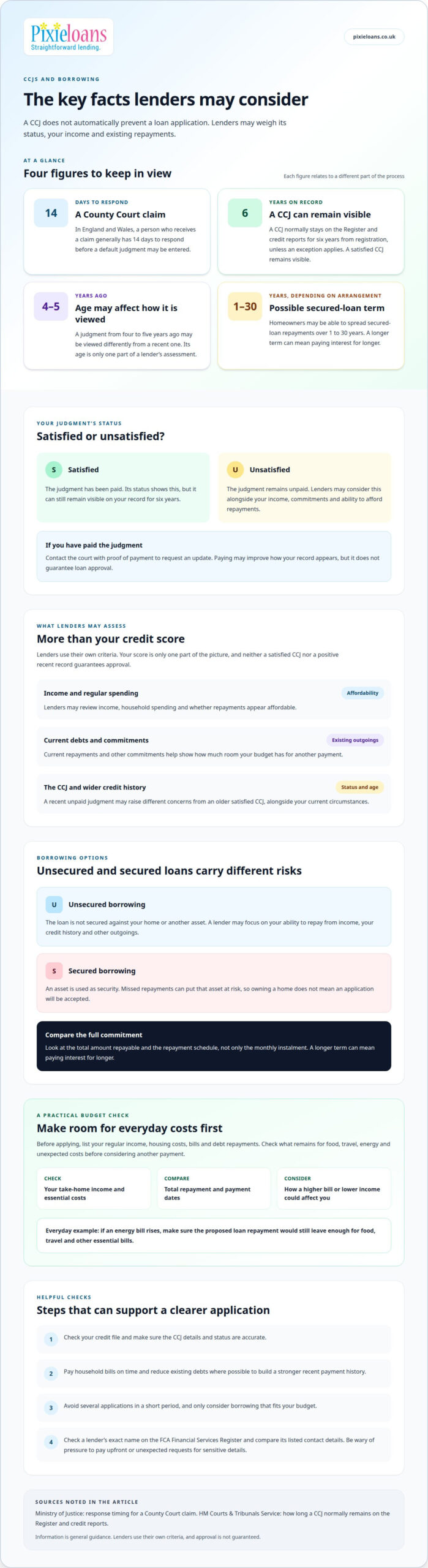
A County Court Judgment is a court order confirming that a debt is owed. In England and Wales, a person who receives a County Court claim generally has 14 days to respond before a default judgment may be entered, according to the Ministry of Justice. A lender may consider a CCJ when assessing a loan application. This recent article explains how the judgment and your circumstances can affect borrowing, including the difference between satisfied and unsatisfied CCJs.
In the UK, a County Court Judgment can be issued when a creditor takes court action over an unpaid debt and a judge agrees that payment is due. A CCJ is a court order that may be registered against someone who fails to repay money owed in England, Wales and Northern Ireland. A court decision about payment, rather than simply an unpaid debt, is central to a CCJ. An unpaid debt does not automatically become a CCJ: a creditor must take court action and a judge must agree that payment is due. The judgment relates to the debt brought before the court.
The lending figures provide context, but they do not define a CCJ. These amounts relate to borrowing examples, not to a County Court Judgment. A small, short-term loan is not suitable for sustained borrowing over longer periods. Late repayment can cause you serious money problems. For help, go to moneyhelper.org.uk. This warning is relevant when considering the repayments shown in the examples; a CCJ itself is a judge’s decision that payment is due on an unpaid debt.
Satisfied and unsatisfied CCJs
You can apply with either status, but lenders assess your circumstances and repayment ability.
Differences between satisfied and unsatisfied CCJs
A satisfied CCJ has been paid; an unsatisfied one remains unpaid. A satisfied judgment stays visible for six years.
Applying with a satisfied or outstanding CCJ
Either status can affect an application. Lenders consider your income, commitments and the judgment’s status.
Considering older CCJs
A judgment from four to five years ago may be viewed differently from a recent one.
Paying off a CCJ and loan chances
Paying may improve how your record appears, but doesn’t ensure approval. Contact the court with proof to request an update. You can provide your circumstances through the loan application form.
Looking for a CCJ loan with no guarantor?
A CCJ can affect your credit history and the options available when you apply without a guarantor. To check a lender, search its exact name on the FCA Financial Services Register and compare the listed contact details. Be wary of pressure to pay upfront or unexpected requests for sensitive details.
Credit ratings and loan eligibility
A CCJ can lower your credit score and make borrowing harder, as lenders may see it as evidence of past repayment difficulties. HM Courts & Tribunals Service says a CCJ normally stays on the Register and credit reports for six years from its registration date, unless an exception applies. A satisfied CCJ remains visible, but its status shows the debt has been paid.
Lenders may assess your income, regular spending, current debts and whether repayments appear affordable. A lender may offer less, charge a higher interest rate or decline your application. Your score is only one part of the assessment, so review your household budget before deciding to borrow.
Credit scores and borrowing
Credit scores can differ between credit reference agencies, and lenders use their own criteria. A CCJ’s age, status and place in your wider credit history can affect how your application is viewed. For example, a recent unpaid judgment may raise different concerns from an older satisfied CCJ, alongside your current income and commitments.
Before applying, check your credit file for accurate CCJ details and note its status. Paying household bills on time, reducing existing debts where possible and avoiding several applications in a short period can help build a stronger recent payment history. These steps don’t erase a CCJ, but they can show how you manage credit now.
A satisfied CCJ or a positive recent record can support the picture lenders assess, but neither guarantees approval. If you need to borrow, request only an amount that fits your budget and consider the total repayment as well as the monthly cost. Leave enough room for everyday expenses, such as food, travel and energy bills, before taking on another commitment. Never borrow an amount that cannot be repaid on your next pay period date.
Unsecured and secured CCJ loans
With a County Court Judgment, borrowing options may include unsecured or secured finance. The main difference is whether you offer an asset as security, which affects the risk and how a lender assesses your application.
UK lenders don’t follow one shared rule for CCJs. Lenders that consider applications from people with bad credit assess your circumstances, including income, existing commitments, the judgment’s status and whether repayments appear affordable. Compare the total amount repayable and repayment schedule to understand an offer. Don’t assume that a secured application will be accepted simply because you own a home.
An unsecured loan isn’t secured against your home or another asset. A lender will focus on your ability to repay from income, alongside your credit history and other outgoings. A secured loan uses an asset as security. Homeowners may be able to spread secured-loan repayments over 1 to 30 years, depending on the lending arrangement. A longer term can mean paying interest for longer, so look beyond the monthly instalment.
With secured borrowing, missed repayments can put the asset used as security at risk. Consider what might happen if your income fell or an essential household bill increased. Before applying, list your regular income, rent or mortgage, bills and debt repayments. Then check whether the proposed payment leaves enough for food, travel and unexpected costs. This affordability check can help you avoid borrowing more than your budget can support.
If high-cost borrowing feels unsuitable, consider other routes before taking on a new loan. In England and Wales, an administration order may be available if you have multiple debts, including at least one CCJ. It can distribute one affordable monthly payment among creditors. If you decide to explore borrowing, complete an application form with accurate details of your finances and CCJ.
Pixie Loans: Short Term Loans
Pixie Loans is a UK credit broker that connects people with independent lenders. If a CCJ has narrowed your options, its Bad Credit Loans may be relevant to explore, alongside Short Term Loans, Payday Loans and Debt Consolidation Loans.
Before applying, decide how much you need and review your regular income, essential bills and existing repayments. For example, if a car repair creates a shortfall, check whether a new monthly payment would still leave enough for rent, food and travel. Borrow only if the repayment plan fits your budget, and consider the total cost as well as each instalment. Pixie Loans can help you explore available borrowing options through its lender network. If you’d like to discuss your circumstances and possible next steps, contact Pixie Loans.
Choose a next step that fits your finances
If you’re wondering whether you can get a loan with a CCJ, focus on what you need to borrow and what you can comfortably repay. Set out your take-home income, essential costs and existing credit commitments. Then decide whether a new repayment would leave enough for everyday expenses and unexpected bills.
Pause before applying and consider whether you need to borrow now. If the expense can wait, saving towards it may reduce pressure on your monthly budget. If you apply, provide accurate details about your circumstances and read the repayment terms carefully before agreeing. A clear picture of your finances can help you make a considered decision.
Pixie Loans can help you explore borrowing options through its lender network. Start an application with Pixie Loans if you’d like to take that next step. Move at a pace that feels manageable, and keep your budget at the centre of your decision.
Frequently Asked Questions
What is a ‘satisfied’ CCJ?
A satisfied CCJ is one where the judgment debt has been paid in full. The satisfied marker records that payment, but the judgment doesn’t disappear immediately, and lenders may treat your application differently. If you’ve cleared the debt, keep evidence of payment. If your credit file shows the wrong status, contact the court about updating the record.
Can I get a bad credit CCJ loan?
You can apply for borrowing with a CCJ, including through bad-credit loan options, but approval depends on the lender’s assessment of your circumstances. Pixie Loans is a credit broker that connects applicants with independent lenders; it doesn’t make lending decisions. Each independent Financial Service Provider may perform a credit check, and Pixie Loans doesn’t participate in that decision. Late repayment can cause you serious money problems. For help, go to moneyhelper.org.uk.
How does having a CCJ impact my ability to secure a loan?
A CCJ can make borrowing harder because lenders may view it as a sign of past difficulty repaying debt. They can also consider your current income, regular outgoings and other credit commitments. Rent, energy bills and existing repayments, for example, affect how much room your budget has for another payment. Review these costs before applying, and avoid making several credit applications close together.
What is a CCJ (and why it matters)?
A County Court Judgment is a court decision confirming that money is owed after a creditor takes legal action. Lenders may see the judgment in your credit history when assessing an application. If you dispute a claim, read the court papers carefully and respond within the stated deadline. Keeping the documents together can help you explain the outcome accurately later.
CCJ loans: Can you get a loan with a CCJ?
Yes, you can apply, but a CCJ doesn’t mean a lender will approve you. The decision can depend on the judgment, your income and whether repayments fit your budget. Before taking credit, compare the total repayment with the monthly amount and consider whether the expense can wait. For help, go to moneyhelper.org.uk.
Can you get a loan with a CCJ in the UK?
Yes, people in the UK can apply for loans with a CCJ, but lender criteria differ and approval isn’t automatic. Before proceeding, compare your income with essential bills and current debt payments, then consider what you could repay from your next pay. Never borrow an amount that cannot be repaid on your next pay period date. For help, go to moneyhelper.org.uk.