
Are Loan Brokers Safe and Legitimate? Check Their Fees and FCA Status
A legitimate loan broker connects you with lenders but does not lend money itself; the lender decides whether to approve your application. So, are loan brokers safe and legitimate? They can be, if you check the broker’s FCA status and understand how it earns money before proceeding.
It’s sensible to be cautious when sharing personal details or considering a loan. A broker may help you find an option, but approval is not guaranteed, and any loan still needs to fit your budget. If you need to cover an unexpected household bill, compare the repayments with your regular outgoings before applying.
This guide explains how brokers differ from lenders, how to check FCA registration and what to look for in a fee notice. It also covers warning signs of loan scams and how to report suspected fraud, so you can make a more informed decision before sharing details or paying a fee.
Key Takeaways
- Know who makes the lending decision: a broker connects you with lenders, but doesn’t provide the loan itself.
- Use the FCA Register to check a broker’s status and whether its listed details match the business contacting you.
- Before agreeing to any broker fee, read the written notice carefully and make sure you understand when and how payment is due.
- Pause if you’re pressured to pay upfront or share payment details, and learn where to report suspected loan fraud.
How does a broker differ from a lender?
Brokers connect borrowers; lenders decide and lend.
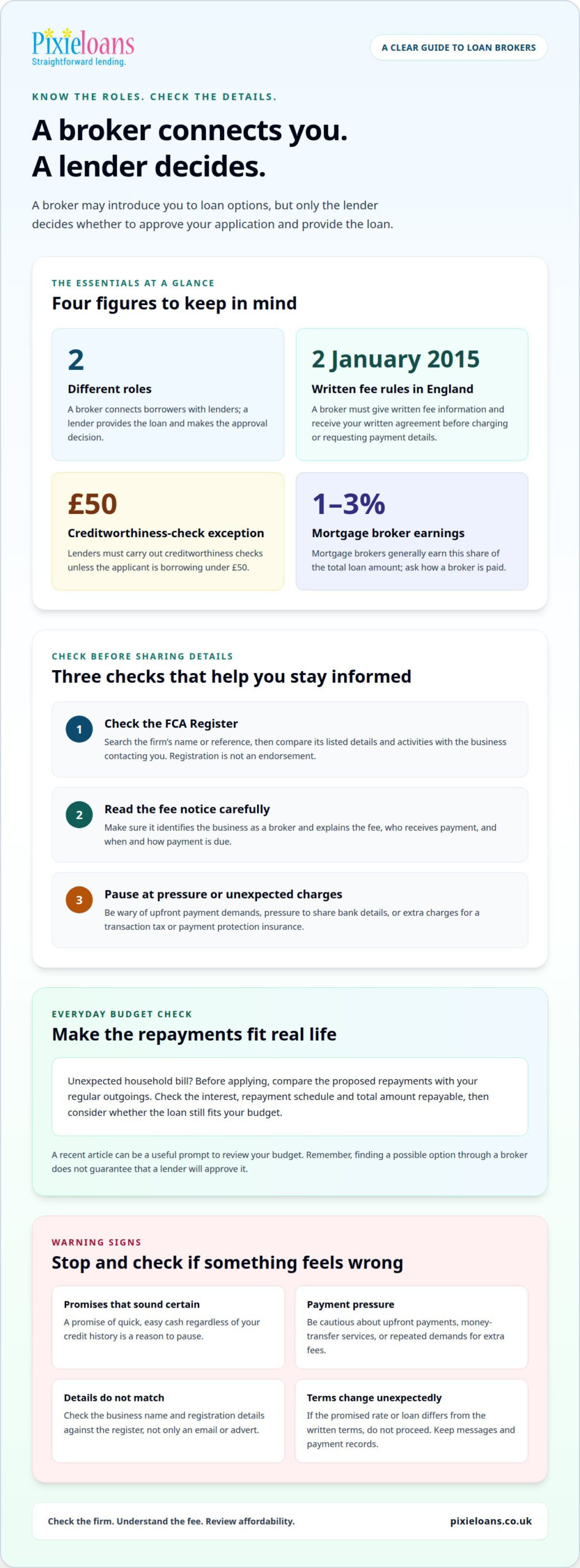
UK Legislation says English credit brokers must identify as brokers, not direct lenders, in customer communications from 2 January 2015.
Bad credit? Lenders’ criteria vary, so check that repayments fit your budget.
Broker and lender roles
Loan officers represent lenders; brokers introduce them.
Access to lenders and loan options
Check Consumer Credit Public Register trading names and activities.
Comparing broker and direct lender offers
Compare interest, repayments and total cost with direct offers.
Creditworthiness and affordability checks
Lenders assess affordability, so use a recent article as a prompt to review your budget.
A loan broker does not lend money; it connects borrowers with lenders and loan products that may suit their needs. A lender offers its own products and makes the decision on whether to lend. When deciding whether to approach a broker or a lender, remember that the broker connects you with possible options, while the lender sets its own terms and decides whether to approve your application. A lender’s product range is not a comparison with what competing lenders offer. This distinction explains why both may appear in a borrowing search but play different roles: one connects borrowers with potential products, and the other provides the loan.
Loan brokers may earn commission from the lender they connect a borrower with, rather than charging the borrower directly. That is one way their role can be paid for, and it does not change the basic distinction: the broker connects, while the lender provides the loan. The Consumer Credit Public Register includes information about trading names and the activities for which a business is licensed, which can help clarify what a business is licensed to do. A broker connection is not a promise that a lender will accept an application. Some lenders may refuse applications from people with a bad credit history, while others may consider lending at higher interest rates. In the UK, lenders must carry out creditworthiness checks unless an applicant is borrowing under £50. These differences mean borrowers should distinguish between finding an option and a lender agreeing to provide it; the broker’s connection does not replace the lender’s assessment.
Financial Conduct Authority authorisation and endorsement
In the UK, credit brokers must be authorised and regulated by the Financial Conduct Authority (FCA), and listed on its register. Registration is not an endorsement of a loan or its interest rate.
FCA authorisation and regulation
FCA regulation applies to credit-broking activities, but not every product or service mentioned in a promotion. Use the FCA Financial Services Register to see the activities recorded for a firm.
Checking the Financial Services Register
Search the firm’s name or reference, then compare its register details with the business contacting you. The FCA’s warning list can also help identify firms it has warned about. A register entry does not mean the FCA recommends borrowing from that firm.
Broker fees and written information notices
In England, from 2 January 2015, a credit broker may charge a fee or request payment details only after giving you a written fee notice and receiving your written agreement. The notice must identify the firm as a broker and explain the fee, when it is due and how it will be paid.
Rules on broker fees do not apply to credit secured on land. If your payment details are passed to another broker, that broker must provide its own notice and receive your agreement before charging.
Before agreeing, check who receives payment and whether the broker also earns lender commission. Compare any charge with the loan’s interest, repayment schedule and total amount repayable.
Check that the firm describes itself as a broker, not a lender, and that its written information explains any charges and when and how they would be paid. In England, a broker that receives your payment details from another broker cannot charge until it has provided its own information notice and you have agreed to the charge.
Mortgage brokers do not have an obligation to secure borrowers the best deal and may benefit from higher fees. They may negotiate with lenders to waive application, appraisal, origination, and other fees. UK mortgage brokers should explain which lenders they can consider, how they are paid, whether a broker fee applies and what service they will provide. Mortgage brokers generally earn between 1% and 3% of the total loan amount.
Scam warning signs and reporting
Pause if a broker promises quick, easy cash regardless of your credit history. A genuine lender considers your application, circumstances and ability to repay. An upfront payment followed by silence is a common loan-scam pattern. Don’t pay before you understand what a third-party charge covers and how the loan would work.
Be cautious if someone asks you to pay through a money transfer service such as Western Union or UKash. Extra demands for a transaction tax or payment protection insurance are also warning signs. Before sharing details, find out whether your information will be passed to another business. If a caller contacts you unexpectedly and pressures you to borrow, end the call rather than giving bank details.
Scammers may copy a real lender’s consumer credit licence or company registration number. Check that the name and details match the business contacting you, not merely a number shown in an email or advert. If the interest rate or promised loan differs from the written terms, don’t proceed. Save messages, emails and payment records; they can help explain what happened when you report suspected fraud.
If you suspect loan fraud, report it through an appropriate channel. If someone lends without the required Financial Conduct Authority licence, they may be a loan shark. Threats over missed repayments, taking your bank card as security, or a debt that keeps growing despite payments are warning signs. You can report a loan shark confidentially and anonymously to the Illegal Money Lending Team.
If you’ve checked the broker and terms, and still need to explore borrowing, you can complete an application form. Don’t apply to resolve a suspected scam or pay money to recover lost funds. First report the incident and contact your bank if you shared payment details or sent money.
Pixie Loans
Pixie Loans can help you explore borrowing options by connecting you with independent lenders. If you’re considering a loan after checking broker status, fees and scam warning signs, it’s still important to assess whether repayments fit your budget.
Depending on your circumstances and borrowing needs, options may include a Personal Loan, Payday Loan, Consolidation Loan, Car Loan, Home Improvement Loan or Cash Advance. If past missed payments make borrowing harder, you can explore options through Pixie Loans’ lender-matching service, but compare the repayment terms carefully and consider whether taking on more credit is manageable.
Before proceeding, review the loan information and any fees, and make sure you understand who the lender is and what you’ll repay. If you’d like to discuss your options, contact Pixie Loans.
Make your next borrowing decision with care
Knowing whether loan brokers are safe and legitimate is one part of deciding whether to borrow. The other is whether repayments can fit alongside essentials, existing credit and unexpected household costs. Before moving ahead, write down your regular bills and current repayments, then work out what remains for food, travel and other needs. If that amount feels tight, pause and reconsider borrowing.
A borrowing decision should have a clear purpose. Replacing a broken essential appliance may feel urgent, but a new repayment still competes with rent and energy bills. Consider whether you can meet the cost another way, and don’t accept an offer just because the application seems straightforward. Proceed only when the payment schedule and total repayable make sense for your budget.
If borrowing remains appropriate, take the next step with Pixie Loans. Share information carefully and review the terms before agreeing to borrow. A calm, considered decision can help protect your budget and give you greater confidence moving forward.
Frequently Asked Questions
What is a credit broker?
A credit broker helps you find loan options by connecting you with independent lenders or other brokers. It does not provide the borrowed money itself. For example, if you’re considering borrowing to replace a broken household appliance, a broker may pass your application to lenders for consideration. Check who would make the lending decision and read the repayment terms before agreeing to proceed.
Are you authorised by the FCA?
Pixie Loans is regulated by the Financial Conduct Authority under reference 848096; Maxed Up Media Ltd is an appointed representative of Serpable Ltd, which is authorised and regulated by the FCA under reference 799104. This describes the business’s regulatory status, not an FCA recommendation of a particular loan. Each independent Financial Service Provider may perform a credit check, and Pixie Loans doesn’t participate in that decision.
How will this affect my credit score?
Taking on debt can affect your credit score, and an independent Financial Service Provider may perform a credit check when considering your application. Pixie Loans does not take part in that decision. Before applying, consider whether repayments fit alongside bills and existing commitments. Late repayment can cause you serious money problems. For help, go to moneyhelper.org.uk.
Should I use a loans broker?
A broker may be useful if you want access to loan options through independent lenders, but borrowing should fit your budget and needs. When considering whether loan brokers are safe and legitimate, check the broker’s status and written terms, and understand how it earns money before proceeding. Never borrow an amount that cannot be repaid on your next pay period date. If repayments would strain essential spending, pause before applying.
Are loan brokers regulated by the FCA in the UK?
In England, credit brokers must be authorised and regulated by the Financial Conduct Authority and appear on the Financial Services Register. FCA regulation doesn’t mean the Authority endorses a broker or every loan it may introduce. It also doesn’t guarantee that a lender will approve your application. Look at the broker’s listed activities and consider the lender’s terms separately before deciding.
How can I check whether a UK loan broker is FCA authorised?
Search the Financial Services Register using the broker’s exact business name or reference number. Compare the result with the name used in its communications, including any trading name, and check that the listed activities relate to credit broking. If a message gives a firm’s details, don’t rely on its logo alone. Matching the business identity and activity helps you assess who you’re dealing with.