
How to Get Out of Debt When You Are Broke: A Practical 2026 UK Guide
What if the secret to clearing your arrears isn’t actually having more money in your bank account? It’s stressful when the phone doesn’t stop ringing and you’re worried about bailiffs. Many people feel trapped when income barely covers rent and food. According to the Money and Pensions Service, millions of UK adults are struggling with debt, so you’re not alone. Learning how to get out of debt when you are broke feels impossible, but it starts with organisation rather than extra cash.
This guide provides a clear path to stop your debts from growing. You’ll discover how to categorise your bills into priority and non-priority groups. If you’re worried about losing your home, then understanding priority debts is your first step to safety. We’ll also show you where to access free, professional UK debt advice from organisations like StepChange. By the end of this 2026 guide, you’ll have a practical plan to manage your finances even when there’s no spare change.
Key Takeaways
- Learn how to get out of debt when you are broke by organising every balance without judgement and recognising that your financial situation is only temporary.
- Safeguard your home and essential services by prioritising payments like rent and council tax over non-priority credit cards or store cards.
- Utilise proven strategies such as the Snowball or Avalanche methods to gain psychological momentum and reduce the long-term cost of your interest.
- Discover how debt consolidation loans or free professional support from UK charities can streamline multiple repayments into one manageable monthly amount.
Facing the Numbers When You Feel Overwhelmed
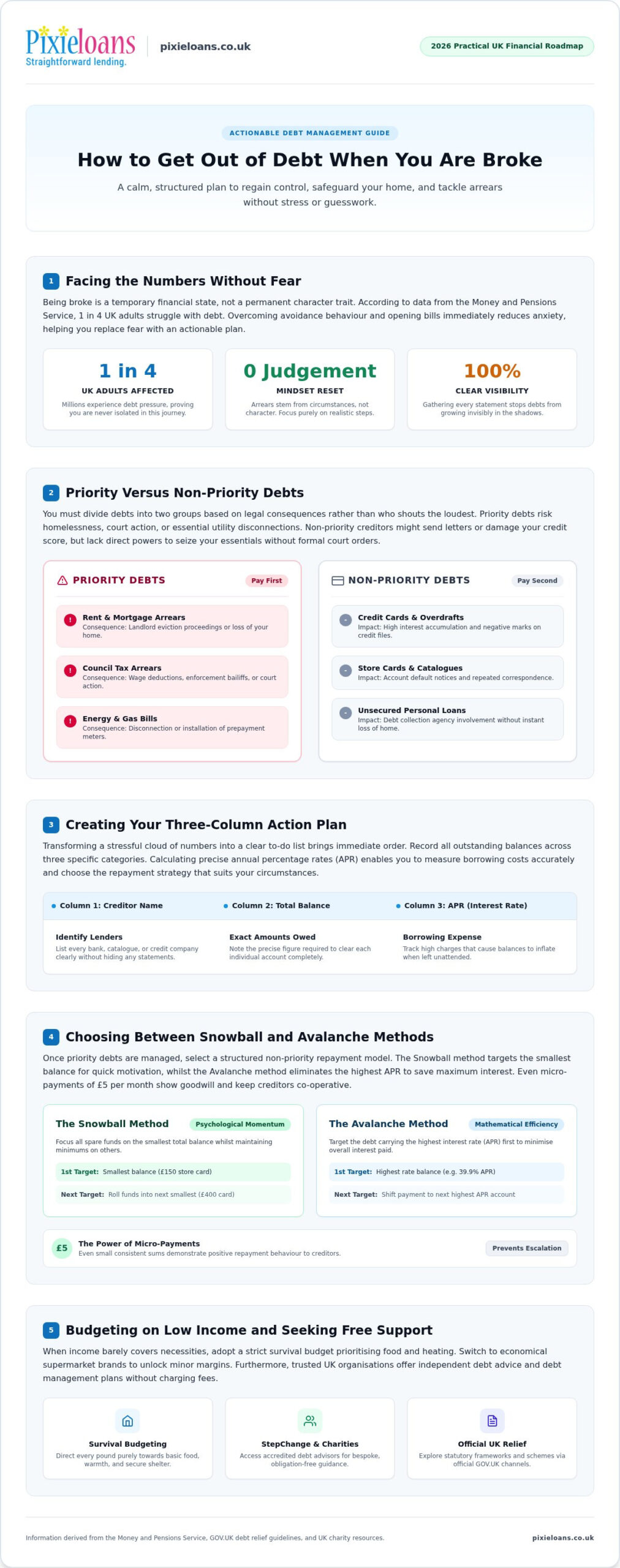
The first step in learning how to get out of debt when you are broke is looking at the numbers without fear. It’s easy to feel judged by a bank balance, but being broke is a temporary financial state, not a permanent character trait. Recent data suggests that 1 in 4 UK adults struggle with debt; you aren’t alone in this experience. Gather every statement you have. To see the full picture, you must know the total amount owed and the interest rates applied to each account.
Organising Your Debts by Interest Rate
Create a simple table with three columns: the creditor’s name, the total balance, and the APR. Knowing the cost of your borrowing helps you decide which debts to tackle first. If you need help visualising your repayments, you can use the repayment calculator to see how different amounts affect your timeline. For some, a formal debt management plan might be a suitable path. Listing these details turns a scary cloud of numbers into a manageable to-do list.
The Psychology of Taking Control
Avoidance behaviour often creates more stress than the debt itself. The moment you open those envelopes and face the figures, your anxiety usually starts to drop. You’re no longer guessing; you’re planning. As financial experts often say, “Action is the best antidote to fear.” Taking control means you’re the one making decisions again. By acknowledging the situation, you stop the debt from growing in the shadows. This mental shift is essential for anyone wondering how to get out of debt when you are broke.
Prioritising Your Debts to Protect Your Essentials
When you’re figuring out how to get out of debt when you are broke, you must separate your bills into two groups. Priority debts are those where the consequences of not paying are life-changing, such as losing your home or facing prison. Non-priority debts include credit cards or store cards. Whilst these creditors might be louder, they don’t have the same legal powers. At Pixie Loans, we believe in a transparent approach to help you understand your financial responsibilities clearly.
Why Rent and Council Tax Come First
Rent and council tax are your highest priorities. Local councils have strong legal powers to deduct money from your wages or send bailiffs to your door. Similarly, landlords can start eviction proceedings if you fall behind. Credit card companies might affect your credit score, but they cannot take your home without a court order. For official guidance on managing arrears, you should visit GOV.UK. Focus your limited funds here first to keep a roof over your head.
Handling Energy Bills and Water Rates
Don’t ignore energy or water bills. If you can’t pay, contact your supplier immediately to discuss a repayment plan. In 2026, several energy support schemes exist for low-income households to prevent disconnection. You might also explore official UK government debt relief options if your total debt is becoming unmanageable. Learning how to get out of debt when you are broke requires protecting these essentials first. If you need to simplify, consider an application for a consolidation loan.
Simple Strategies to Clear Debt Whilst Broke
Once you’ve prioritised your essentials, you can start tackling your remaining balances. The Snowball Method focuses on paying the smallest debts first for quick psychological wins, whilst the Avalanche Method targets high-interest rates to save money long-term. Even if you only have £5 a month, making micro-payments shows creditors you’re willing to pay. This proactive behaviour can prevent further legal action and help you understand how to get out of debt when you are broke. Taking these small steps today builds the foundation for a much brighter financial future.
The Snowball Method for Quick Wins
The Snowball Method is ideal for building confidence. Start by listing your non-priority debts from smallest to largest balance. Pay the minimum on everything except the smallest debt, then put any spare cash toward that one. Once it’s cleared, you’ll feel a huge sense of relief. Move that entire payment amount to the next smallest debt. This psychological momentum helps you stay on track and ‘clears the desk’ of small, annoying bills.
Budgeting with Zero Disposable Income
A survival budget focuses strictly on your absolute needs like food and shelter. Look for tiny savings, such as switching to cheaper supermarket brands, to find extra cash. Use the Pixie Loans calculator to plan these small payments. If you want to simplify multiple high-interest bills, you can start an application for a debt consolidation loan. Merging your debts into one monthly payment can reduce your daily stress significantly.
Consistency matters more than the amount you pay. By using these strategies, you take back control from your creditors. You’re moving from a state of panic to a state of planning. This is the most effective way to learn how to get out of debt when you are broke.
When to Seek Professional Help or Consolidation
If you’ve tried managing your budget and still feel overwhelmed, it’s time to look at external support. Understanding how to get out of debt when you are broke often requires expert intervention or a change in how your debts are structured. Professional advice is available for free, and for many, merging debts into one manageable payment is the most sustainable path forward. You should always ensure that any new financial arrangement makes your total cost lower rather than just delaying the problem.
Free UK Debt Advice Charities
Organisations like StepChange and Citizens Advice provide confidential support at no cost to you. They are the primary centres for debt help in the UK and can offer a lifeline when you feel there is no way out. These charities can help you set up a Debt Management Plan (DMP). This involves negotiating with your creditors to lower monthly payments to a level you can actually afford. They can also advise on statutory relief options if you have no disposable income at all.
Is a Debt Consolidation Loan Right for You?
A debt consolidation loan can be a practical tool to simplify your financial life. It works by merging multiple high-interest debts into one single monthly payment. This can reduce your daily stress and make your outgoings much easier to track. However, you should only proceed if the interest rate and terms are suitable for your specific needs. It’s about making your debt more manageable, not creating a larger burden. You can use our loan calculator to see how different repayment figures might look for your budget.
Taking action is the most important step. If you’ve assessed your situation and decided that merging your balances is the right choice, you can complete our application form to find a potential match. Learning how to get out of debt when you are broke is a journey that requires patience, but with the right guidance and tools, you can regain control of your future.
Taking Your Next Steps Toward Financial Freedom
Clearing your arrears is a journey that begins with a single, honest look at your bank statements. By categorising your bills and protecting your home through priority payments, you’ve already started the process. Remember that being broke is a temporary situation, not a permanent label. Using structured methods like the Snowball strategy helps build the psychological momentum needed to stay on track. Learning how to get out of debt when you are broke is about consistent, small actions rather than finding a sudden windfall.
If you’re ready to move from planning to action, merging your high-interest balances could be a helpful step. Pixie Loans is a UK-based credit broker that specialises in bad credit solutions. We offer an online platform to match you with suitable lenders, and there are no fees for our matching service. You can apply for a debt consolidation loan to simplify your monthly payments today. Take control of your finances; a debt-free future is possible with the right plan and support.
Frequently Asked Questions
Can I get debt help if I have no money at all?
Yes, you can access professional support even with zero surplus income. UK charities like StepChange and Citizens Advice offer free, confidential guidance. They can negotiate with your creditors to freeze interest and charges whilst you stabilise your finances. A Debt Management Plan can be tailored to your specific situation. Never pay a fee for debt advice when these registered charities provide it for free to anyone struggling.
What is the ‘Breathing Space’ scheme in the UK?
The Debt Respite Scheme, commonly known as ‘Breathing Space,’ provides 60 days of legal protection from creditor action. During this period, interest and enforcement charges are frozen to give you time to seek advice. To access this support, you must apply through a qualified debt adviser. This scheme is essential for those learning how to get out of debt when you are broke, as it stops the immediate pressure.
Will my credit score be ruined forever if I am broke?
No, a low credit score is not a permanent condition. Whilst missed payments or defaults remain on your credit file for six years, their negative impact reduces as time passes. By maintaining responsible financial behaviour, your score will eventually recover. You should focus on your survival and priority bills first. Rebuilding your credit profile is a secondary step that follows once your essential living costs are secured.
Should I use a loan to pay off my debts?
A debt consolidation loan is a useful tool if it reduces your interest costs and simplifies your monthly outgoings. As a credit broker, Pixie Loans helps you compare options from various independent lenders to find a suitable match. However, you must ensure the new repayments are affordable within your budget. Using a loan effectively is a strategic way to manage how to get out of debt when you are broke.
What happens if I cannot pay my Council Tax?
Council Tax is a priority debt because local authorities have strong legal powers to recover money quickly. If you fall behind, councils can use bailiffs or deduct payments directly from your wages. You should contact your local council immediately if you are struggling. They can often help by spreading your payments over 12 months instead of 10, which reduces the monthly pressure on your household budget.