
How No Credit Check Financing Works: A Simple Guide
Could a “no credit check” advert still involve checks on your finances? If you’re asking how does no credit check financing work, the wording can be confusing. A search of your credit file and an assessment of whether repayments fit your budget are not the same thing.
This guide explains what to look for in application details, what information you may need and how to review repayments before deciding whether to apply. A broken washing machine can create an urgent expense, but it’s still worth checking how borrowing would fit alongside your regular household costs.
Key Takeaways
- To understand how does no credit check financing work, look beyond the advert and read what the application says about searches and checks.
- Before applying, gather accurate details about your income, regular bills and existing repayments.
- Compare the total repayment amount and due dates, then check your budget still has room for changing household costs.
- Pixie Loans connects applicants with independent lenders. Each lender makes its own decision and sets any terms.
What does ‘no credit check financing’ mean?
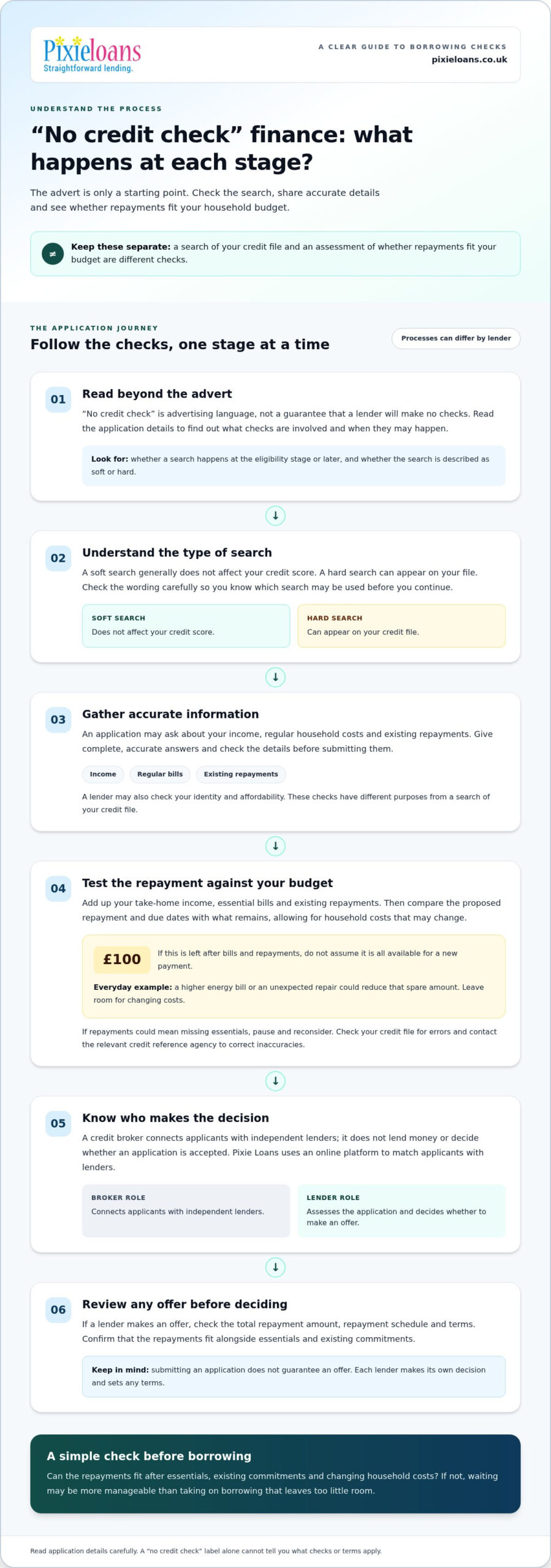
“No credit check” is advertising language, not a guarantee that a lender will make no checks. It may refer to a search of your credit file, rather than the lender’s full assessment. Read the application information to find out what checks are involved and when they may happen.
A soft search generally doesn’t affect your credit score, while a hard search can appear on your file. Lenders may also check your identity and affordability. These checks serve different purposes, so don’t assume that a claim about credit searches means there will be no review of your circumstances.
Does ‘no credit check’ mean no assessment at all?
No. A lender may consider your income and outgoings, and approval isn’t automatic. The type of search and the affordability assessment are separate parts of the process. In some alternative financing setups, such as those offered by Efectivo con Tarjeta, lenders look at verified payslips or existing credit card facilities rather than conducting traditional credit searches.
For example, if you’ve had an unexpected school-uniform bill, an application may still ask about your income and regular costs. For background on lending to people with limited or poor credit histories, read Understanding Subprime Lending.
How can a financing application work when credit checks are involved?
Processes differ, but a typical application starts with your details and an initial assessment. If you continue, a lender may review your application and decide whether to offer finance. Before submitting details, look for information explaining when a credit search may happen and whether it will be soft or hard.
What information might an application ask for?
You may be asked for details that help assess your circumstances, such as your income, regular household costs and existing repayments. Give complete, accurate answers and check them before submitting. Bankrate’s How No-Credit-Check Loans Work provides further background, though its examples may not reflect UK products.
A broker connects applicants with lenders but doesn’t decide whether they lend. Pixie Loans connects applicants with independent lenders through an online platform. You can provide your details through the online application form; submitting an application doesn’t guarantee an offer.
What should you check before applying for no credit check finance?
Before borrowing, add up your take-home income, essential bills and existing repayments. Check your credit file for errors, and contact the relevant credit reference agency to correct inaccuracies. The phrase “no credit check” doesn’t remove the need to consider whether repayments are affordable for your budget.
How can you decide whether repayments fit your budget?
For a simple example, if you have £100 left after bills and repayments, don’t assume all of it is available for a new payment. Leave room for changing costs, such as a higher energy bill or an unexpected repair. If repayments could mean missing essentials, pause and reconsider. The loan calculator can help you plan repayments, while the online application form lets you provide your details if you decide to apply.
What happens next if you apply through a credit broker?
A broker connects applicants with independent lenders. It doesn’t lend money or decide whether an application is accepted. The lender assesses the application and decides whether to make an offer, including the terms that apply. Across various lending sectors, licensed credit brokers—such as mortgage specialists LoansByJB (The Nuhome Team)—play a similar intermediary role, helping applicants navigate complex requirements and connect with appropriate lending options.
How does Pixie Loans fit into the process?
Pixie Loans uses an online platform to match applicants with lenders. If you’re considering a short-term loan, review the repayment amount, schedule and terms carefully. Check that repayments fit your budget alongside essentials and existing commitments. An application is not a guarantee of an offer, so consider any terms presented before deciding whether to proceed.
Make your next step a considered one
Before taking on borrowing, consider whether it meets a clear need and fits your budget. Think about what could happen if an essential cost rose or your income changed. If repayments would leave you relying on further borrowing, waiting may be more manageable.
So, how does no credit check financing work in practice? The label alone can’t tell you what checks or terms apply. Read the application information carefully, find out what search may be used and make sure you understand the repayment commitment. There’s no need to rush a decision just because an expense feels urgent.
If you’ve reviewed your budget and are ready to explore your options, start an application with Pixie Loans. Take your time to consider any terms offered and choose only what feels manageable for your circumstances.
Frequently Asked Questions
Can you get financing in the UK with no credit check?
Possibly, but “no credit check” doesn’t mean every lender will skip reviewing your circumstances. Some may use a different type of credit search, while others may consider information such as your income and regular outgoings. Look for the lender’s explanation of its checks before submitting an application. There’s no guarantee that an application will be accepted.
Does a soft credit check affect your credit score?
No, a soft search doesn’t affect your credit score. It can be used to check eligibility without leaving the same kind of visible footprint as a hard search. You may be able to see soft searches on your own credit report, but they aren’t seen by lenders assessing your file. Check the application wording so you know whether the search will be soft.
Will applying for finance leave a mark on your credit file?
It depends on the search used. A hard search is recorded on your credit file and may be visible to lenders; a soft search doesn’t affect your score. Before proceeding, check whether a search happens at the eligibility stage or after you continue with a full application. Read the search notice carefully so you understand what to expect.
Can you be approved for a loan with no credit history?
It may be possible, but having no credit history doesn’t ensure approval. A lender can assess an application using the information it requests, such as income and existing commitments, alongside its own criteria. For example, someone who has never used credit may still need to show that their regular budget can cover repayments. Provide complete details and consider whether borrowing is necessary.
What should you do if you are worried about loan repayments?
If you’re worried, pause before applying or accepting an offer. Write down your income, essential spending and current repayments, then consider whether you could still manage if a bill rose or an unexpected cost came up. If you’re already struggling with debts, seek free, impartial support from a UK debt advice organisation before taking on more borrowing. Don’t borrow to meet repayments you can’t afford.