
Child Benefit Loans: A Comprehensive Guide for UK Parents in 2026
What if the weekly payment you receive for your children could serve as more than just a contribution toward the grocery shop?
If you have ever been stressed about an unexpected car repair, you might have felt that your income is not typical for a regular bank.
Many parents in the UK commonly worry that depending on benefits could either result in automatic rejection or push them towards borrowing from high-interest lenders.
A child benefit loan can help cover financial gaps. It uses your current HMRC payments to provide credit. This can be a more organized and affordable way to borrow money while getting benefits. Informally, you may see these described as "loans on child benefit uk" or broader "loans for parents," reflecting their role in family finance uk.
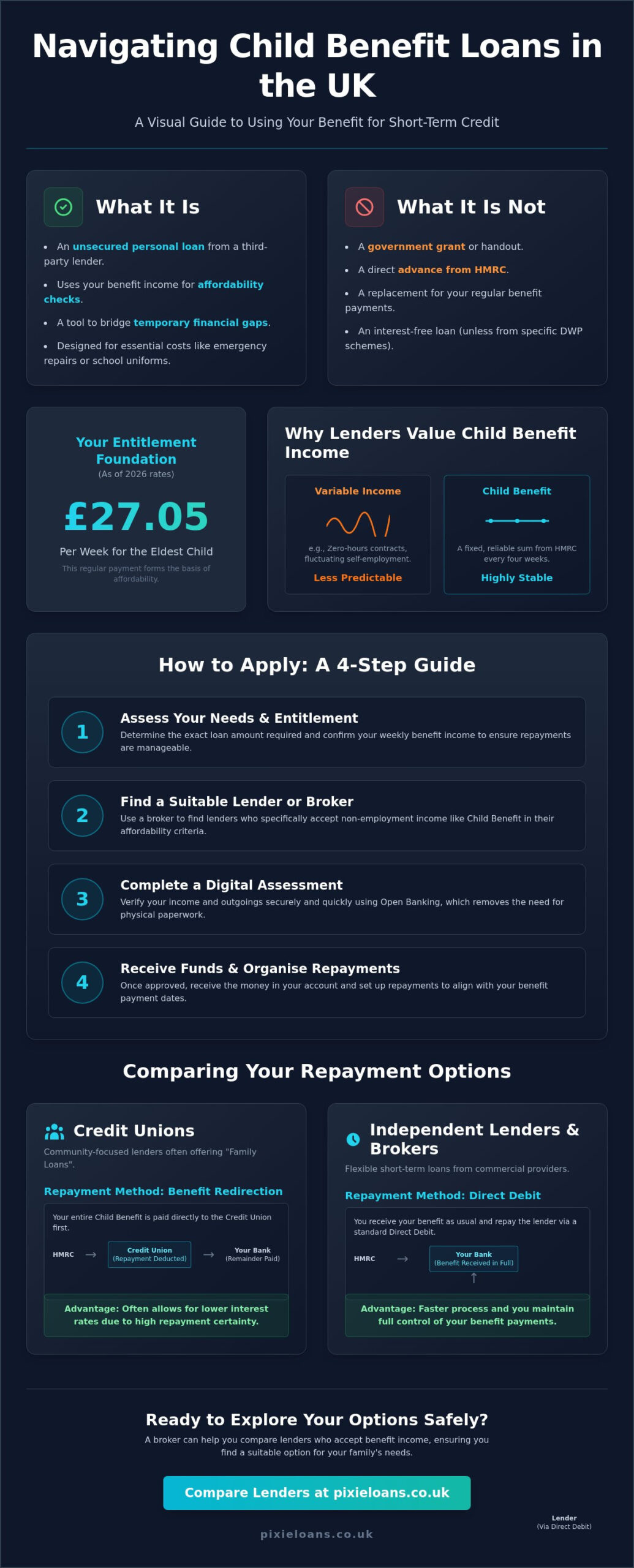
We’ll show you how these loans operate within the 2026 financial landscape, where rates for the eldest child sit at £27.05 per week. You’ll discover the vital differences between borrowing from a local credit union versus using a broker that might connect you to higher-cost options.
If you understand how to navigate this process safely, you can make an informed choice that protects your household budget. We’ll break down the eligibility rules, the impact of the High-Income Child Benefit Charge, and the practical steps to secure a loan that fits your specific needs whilst keeping your family’s financial health as the priority.
Key Takeaways
- Understand how lenders evaluate non-employment income and why the consistency of HMRC payments can help you access structured credit options.
- Discover the practical steps to apply for a child benefit loan, from assessing your weekly entitlement to using a broker to find suitable lenders.
- Understand the role of credit checks and how to navigate the application process if you’re concerned about your current credit rating.
- Evaluate the differences between credit union redirection schemes and independent lender direct debits to choose the most efficient repayment method for your budget.
- Learn how a broker acts as a pragmatic facilitator to help you compare multiple lenders and identify the most suitable borrowing option for your family.
Table of Contents
- ++Understanding Child Benefit Loans in the UK++
- ++How Borrowing Against Child Benefit Works++
- ++Eligibility and the Role of Credit Checks++
- ++Comparing Credit Unions, Lenders, and Broker Options++
- ++Navigating the Application Process Safely with Pixie Loans++
Understanding Child Benefit Loans in the UK
Many parents assume a child benefit loan is a government grant or a direct advance from HMRC, but it’s actually a commercial or community-based credit product. In simple terms, it’s an unsecured personal loan where the lender includes your benefit income as a primary factor in their affordability assessment.
HMRC doesn’t give these funds directly. However, the money you get from Child Benefit helps you when you borrow from other lenders. It helps families get credit for important expenses, like school uniforms or emergency boiler repairs, when their job income isn’t enough for a bank’s rules.
These loans are functional tools designed to help bridge a temporary financial gap. You might use one to replace a broken washing machine or to cover the upfront costs of a school trip. Because they’re usually unsecured, you aren’t putting your home or assets at risk.
However, it’s vital to remember that these are not "advances" on your next payment in the legal sense; they’re formal credit agreements that require regular repayments. If you’re considering this route, you’re looking for a way to use your existing income more flexibly to manage unexpected household pressures.
The Different Types of Loans for Parents
Community-focused credit unions often offer specific "Family Loans." These typically involve redirecting your benefit payment directly to the union’s account. They deduct their repayment and then pass the remainder back to you.
This setup often allows for lower interest rates because the lender has a high degree of certainty about being repaid. These family-focused loans for parents are straightforward and widely available through credit union loans uk.
Alternatively, independent lenders and brokers provide flexible short-term personal loans where you maintain full control of your benefit payments. You’ll typically set up a Direct Debit for repayments, which is often a faster route for those who don’t want to change where their HMRC payments are sent. If you’re on Universal Credit, you might also consider Budgeting Advances from the DWP, which are interest-free but strictly for essential items.
Why Lenders Value Child Benefit Income
Lenders look for stability above all else. In an economy where zero-hours contracts and fluctuating self-employment income are common, the fixed nature of Child Benefit is highly attractive to credit providers. It provides a level of predictability that a variable wage cannot match. When a lender sees that you have a guaranteed sum arriving every four weeks, it significantly reduces your risk profile in their eyes. Child Benefit is a stable income stream that helps satisfy affordability checks. This reliability means that even if you have a lower credit score, the presence of this benefit can sometimes open doors that traditional high-street banks might keep closed.

How Borrowing Against Child Benefit Works
If you’re ready to explore a child benefit loan, the process is structured to ensure you can manage the repayments without compromising your family’s essential needs. The journey begins with a clear assessment of your current financial standing. You should first verify your exact entitlement by checking the ++official government guidance on Child Benefit++ to confirm your 2026 rates, which currently sit at £27.05 per week for the eldest child. Once you have a firm grasp of your income, the borrowing process typically follows four logical steps:
- Step 1: Determine the total amount needed and check your weekly/monthly benefit entitlement to ensure the loan is proportionate to your needs.
- Step 2: Use a broker to identify which lenders on their panel specifically accept "non-employment" income for their affordability criteria.
- Step 3: Complete a digital affordability assessment, which often uses Open Banking to securely verify your benefit income and regular outgoings.
- Step 4: Receive your funds and organise your repayments to coincide with the specific dates your benefit hits your bank account.
Selecting a child benefit loan that aligns with your budget is a key part of this process. Most modern lenders prefer the transparency of Open Banking because it allows for a faster decision without the need for physical paperwork. If the lender approves your application, the money is usually transferred directly to your nominated account. From this point, the focus shifts to maintaining a consistent repayment schedule that fits within your existing household budget.
The Mechanics of Repayment
You’ll generally encounter two repayment methods. Credit unions often use benefit redirection, where HMRC pays the money directly to them first. Most independent lenders, however, use a Direct Debit from your personal account. If you choose the latter, you retain more control, but you must ensure the funds are available.
A useful tip is to set your repayment date one day after your benefit usually arrives. This creates a "buffer zone" for bank holidays or weekends when payments might shift, preventing potential failed transaction fees.
Responsible Budgeting whilst Repaying
Borrowing against your benefit income requires a careful look at your long-term family budget. You should calculate your surplus income before committing to any new credit agreement to ensure you aren’t over-stretching your resources.
The priority is always the child’s actual needs, such as food, clothing, and health. If the loan repayment leaves you short for these essentials, the credit may not be suitable for your circumstances. By borrowing only what is strictly necessary, you protect your household’s financial stability. If you want to see which options are available for your situation, you can ++check your eligibility++ through our broker platform.
Eligibility and the Role of Credit Checks
If you’re worried about having a less-than-perfect credit history, you aren’t alone. The most frequent question parents ask is whether they can secure a child benefit loan with bad credit. Whilst a poor credit score can make traditional high-street borrowing difficult, many lenders in this space prioritise your current affordability over past financial mistakes.
It’s a common misconception that certain providers offer "no credit check" loans. In reality, the Financial Conduct Authority (FCA) requires all regulated lenders to perform some level of assessment to ensure they’re lending responsibly.
There is a significant difference between a "hard" and a "soft" credit search. When you use a broker to explore your options, they’ll typically perform a soft search. This allows them to see your financial summary without leaving a mark on your credit file that other lenders can see.
If you’ve been rejected elsewhere, this is a much safer way to shop around. Before you commit to commercial credit, it’s always wise to check if you’re eligible for a ++Budgeting Loan++ from the government, which is interest-free and designed specifically for those on certain benefits.
Lenders today are moving away from rigid credit scores. They’re far more interested in the ratio between your income and your outgoings. If your Child Benefit is consistent and your bank statements show you manage your bills well, you may find a lender willing to help even with a thin credit file.
This shift ensures that responsible parents aren’t locked out of the financial system simply because they haven’t borrowed much in the past.
Open Banking: A Modern Way to Prove Affordability
In 2026, Open Banking has become the standard for proving you can afford credit. It provides lenders with a read-only, real-time snapshot of your bank account. Instead of you needing to post physical award letters or PDF bank statements, the technology securely shares your transaction history. Open banking loans are creating a fairer landscape for UK borrowers by focusing on what you can actually afford right now, rather than relying solely on historical credit data.
It’s a highly secure process where you remain in control. This is particularly helpful for parents who manage their money well but have a low credit score; the lender can see the actual evidence of your HMRC payments and your commitment to your regular bills.
Common Eligibility Criteria for UK Parents
Whilst every lender on a broker’s panel has their own specific rules, most share a core set of requirements. To be considered for a child benefit loan, you’ll generally need to meet the following criteria:
- Residency: You must be a permanent UK resident with a valid address.
- Age: Applicants typically need to be at least 18 years old, with some lenders having upper age limits around 65 or 70.
- Proof of Benefit: You’ll need to demonstrate you’re currently receiving Child Benefit, usually via bank statements or a recent award letter.
- Bank Account: A valid UK bank account capable of setting up Direct Debits or receiving transfers is essential.
Comparing Credit Unions, Lenders, and Broker Options
Choosing the right path for a child benefit loan depends largely on whether you prioritise the lowest possible interest rate or the speed of the fund transfer. Credit unions and commercial lenders offer distinct advantages, and understanding these differences helps you make a responsible choice for your family.
If you’re facing an immediate financial crisis, such as an emergency repair, the speed of a broker-led application often outweighs the slower, community-focused approach of a local bank or union.
The primary difference lies in the repayment mechanism. Credit unions typically insist on "benefit redirection," where your HMRC payment is sent directly to them. They take their cut and then send the rest to you. Whilst this provides the lender with security, it can feel restrictive.
In contrast, independent lenders usually set up a Direct Debit from your existing account. This allows you to retain full control over your benefit payments, though it requires more diligent budgeting on your part. For those looking for broader options beyond benefit-linked credit, exploring 200 loan options can provide a wider context of small-sum borrowing in the UK credit market.
The Pros and Cons of Credit Unions
- Pros: They generally offer lower interest rates than commercial lenders. Many also operate a "save as you borrow" scheme, which helps you build a small nest egg whilst you repay the debt. These benefits are a hallmark of credit union loans uk, which emphasise community support.
- Cons: The application process is often slower. You may need to become a member first, and the mandatory redirection of your benefits can take several weeks for HMRC to process.
The Pros and Cons of Using a Credit Broker
- Pros: A broker provides a single application that reaches multiple lenders simultaneously. This increases your chances of approval if you have a poor credit history and is typically the fastest way to access funds. Many brokers now use open banking loans technology to assess your real-time financial behaviour, giving you a fairer chance of approval based on your current circumstances rather than past credit history.
- Cons: Interest rates can be higher than those offered by non-profit credit unions. The relationship is strictly commercial, meaning there is less focus on community support or mandatory savings.
If you need a quick decision to manage an urgent household expense, using a broker to compare multiple lenders is a pragmatic choice. You can ++apply for a loan online++ to see which lenders on our panel are ready to assist with your specific circumstances and provide a child benefit loan that fits your needs.
Navigating the Application Process Safely with Pixie Loans
Pixie Loans acts as a pragmatic facilitator, connecting you with an extensive panel of lenders rather than acting as a direct source of funds. This intermediary role is designed to save you time and effort. Instead of submitting multiple applications to different companies, you complete a single form. Our platform then searches for a favourite match based on your specific financial circumstances and the lenders’ unique criteria for a child benefit loan.
This process is transparent; we don’t charge any upfront fees for our brokering services.
Accuracy is your greatest asset during this stage. You must be entirely honest about your income and outgoings to ensure that any child benefit loan you are offered is truly affordable. If you provide inaccurate data, you might be matched with a product that places unnecessary strain on your household budget.
We prioritise your financial health, and being truthful helps us guide you toward a solution that fits your life without compromising your family’s stability. By letting a broker handle the search, you gain access to a variety of lenders that you might not have found through a standard bank search.
What You Will Need to Apply
Preparation makes the journey much smoother. Before you begin, gather your essential documents so you don’t have to pause mid-application. You’ll typically need a valid form of ID, your current bank details, and proof of your UK address.
Having your Child Benefit award letter nearby can also speed up the verification process, especially if a lender needs to confirm your entitlement manually. It’s also a sensible idea to check your current bank balance and recent transactions. Knowing your "real" outgoings, rather than just an estimate, ensures your application is grounded in reality and reflects what you can realistically afford to repay each month.
Final Checks Before You Borrow
We encourage a "common sense" approach to every borrowing decision. Before you sign any agreement, ask yourself if the loan is for a genuine need or a temporary want. If you’re using the funds for an essential household repair or a critical family expense, it serves a clear purpose. If the purchase can wait until you’ve saved the funds, that might be the more responsible path.
Always use a loan calculator to review the total cost of credit, including the interest you’ll pay over the full term. This ensures there are no surprises during the repayment period. If you’ve assessed your budget and decided to move forward, you can ++apply for a loan through Pixie Loans++ to explore your options today.
Securing Your Family’s Financial Future with Informed Choices
Understanding how your HMRC payments can support your credit options is a significant step toward managing your household budget with confidence.
A child benefit loan isn’t just about bridging a gap; it’s about using a stable income stream to access credit that reflects your actual ability to pay. By focusing on modern affordability tools like Open Banking and choosing between the speed of a broker or the community focus of a credit union, you can find a solution that protects your family’s daily essentials and strengthens family finance uk planning.
If you’ve decided that a commercial loan is the right path for your circumstances, we’re here to act as your pragmatic facilitator. Pixie Loans is an FCA authorised credit broker with access to a wide panel of UK lenders, including specialists in bad credit matching.
We don’t charge any upfront fees, ensuring you can explore your options without added financial pressure. Taking a common-sense approach to borrowing helps you resolve immediate needs whilst keeping your long-term goals in sight.
++Find a loan that fits your family budget with Pixie Loans++ today and take a positive step toward organising your finances.

Frequently Asked Questions
Can I get a child benefit loan if I am not working?
Yes, you can often secure a child benefit loan even if you don’t have a traditional job. Lenders in this sector specifically recognise HMRC payments as a valid and stable form of income. Whilst you’ll still need to pass an affordability assessment to ensure you can manage the repayments, your status as a non-worker won’t automatically disqualify you. The lender will simply look at your total benefit income against your monthly outgoings.
Will applying for a child benefit loan affect my credit score?
The impact on your credit score depends on the stage of your application. When you use a broker to compare options, they typically perform a soft search which has no effect on your credit rating. However, if you proceed with a specific lender and submit a full application, they’ll usually carry out a hard credit check. This check will be visible to other lenders and may cause a small, temporary dip in your score.
How much can I borrow against my child benefit?
Loan amounts vary significantly between different providers and your individual circumstances. New customers at credit unions often find limits around £300 to £500 to begin with. Independent lenders on a broker’s panel may offer higher amounts, sometimes up to £5,000, depending on your total household income and affordability. You should only ever borrow the minimum amount required to cover your specific emergency or essential purchase.
Can I have more than one loan at a time?
It is technically possible to hold multiple loans, but it’s rarely advisable for your financial health. Lenders will examine your existing debt-to-income ratio during the application process. If they feel that an additional repayment will put your family budget under too much pressure, they’ll likely decline the request. Managing a single loan responsibly is a much safer way to protect your surplus income and maintain your credit standing.
What happens if my child benefit stops whilst I am still repaying the loan?
You remain legally responsible for the debt even if your benefit payments cease. If your circumstances change, perhaps because a child has left education, you must contact your lender immediately. They can often transition your repayment method from benefit redirection to a standard Direct Debit. Being proactive helps you avoid missed payment fees and protects your credit file from defaults during a period of transition.
Is there a difference between a child benefit loan and a crisis loan?
Yes, there’s a fundamental difference between these two financial tools. A crisis loan, or local welfare assistance, is typically provided by your local council or the DWP for absolute emergencies and is often interest-free. A child benefit loan is a commercial credit product provided by a credit union or private lender. Whilst it’s flexible, it includes interest charges that you must factor into your long-term budgeting plans.
How quickly can I get the money if I am approved?
Speed depends on the type of lender you choose. Many independent lenders and brokers aim for a fast turnaround, often transferring funds within 24 hours of final approval. Credit unions might take slightly longer, sometimes a few working days, as they may need to process your membership or wait for HMRC to confirm a benefit redirection. If you have an urgent repair, a broker-led application is usually the most efficient route.
Can I repay my loan early to save on interest?
Most regulated UK lenders allow you to settle your debt before the end of the term. Repaying early is a pragmatic way to reduce the total amount of interest you pay over the life of the loan. Some lenders might charge a small early settlement fee, so it’s wise to check your original agreement first. If you find yourself with extra funds, clearing the balance early can provide significant peace of mind.
How does the High-Income Child Benefit Charge (HICBC) affect getting a child benefit loan?
The HICBC doesn’t stop you from applying, but it can change how lenders view your income. If you still receive Child Benefit and repay the charge via Self Assessment, lenders can see regular HMRC payments and may accept them in affordability checks or redirection schemes. If you’ve opted out of receiving Child Benefit due to HICBC, you usually can’t use credit-union redirection and will need to evidence affordability from other income streams. In all cases, lenders focus on your current income-versus-outgoings rather than tax positioning.
Do I have to redirect my Child Benefit to a lender to qualify?
Not always. Credit unions often require "benefit redirection," where HMRC pays your Child Benefit to the union first, then they pass the remainder to you—this can mean lower rates but slower setup. Most independent lenders don’t require redirection; they use a Direct Debit from your existing bank account, which is typically faster and lets you keep full control of your HMRC payments.
Is Open Banking mandatory, and is it secure?
It’s not legally mandatory, but in 2026 most lenders prefer Open Banking because it provides a secure, read-only view of your transactions to verify HMRC payments and outgoings quickly. You stay in control and must consent before any data is shared. If you decline Open Banking, you may be asked for statements or award letters instead, which can slow the decision.
What should I prepare before I apply to improve my chances?
Gather a valid photo ID, proof of UK address, your bank details, and (if available) your Child Benefit award letter. Check your exact entitlement (for 2026 the eldest child rate is £27.05 per week) and list your regular bills so your affordability figures are accurate. If approved, consider setting your Direct Debit one day after your benefit arrives to create a buffer for weekends or bank holidays. Using a broker typically starts with a soft search, helping you compare lenders without impacting your credit score.
I’m on Universal Credit—should I try a DWP Budgeting Advance before a commercial loan?
Yes. Interest-free government options like Budgeting Advances (for UC claimants) or Budgeting Loans (for certain benefits) should be checked first for essential expenses. If you’re ineligible or the amount/timing doesn’t meet your need, a broker-led application to commercial lenders can be faster—but will include interest—so compare total cost, speed, and repayment method before deciding.
Related links
How do I get a loan from a Credit Union
How can I get a fast 200 pound loan